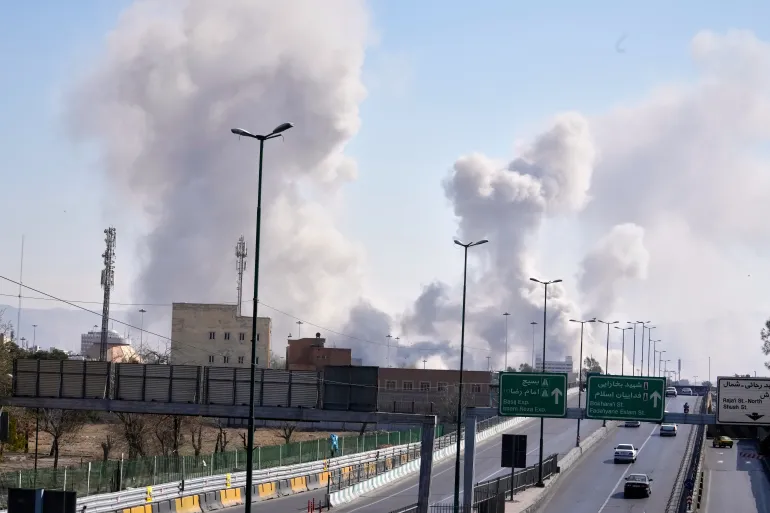
The Tehran heavy bombing US Israel war intensified dramatically as powerful explosions hit the Iranian capital on the seventh day of fighting. Warplanes struck several areas linked to government and security forces, sending thick smoke into the skyline and forcing residents to seek shelter.
Officials reported that fighter jets targeted infrastructure connected to Iran’s internal security command and paramilitary units. Several neighborhoods in and around the city experienced loud blasts and air-defense fire overnight. Tehran has become a central battleground as the conflict between Israel, United States, and Iran escalates.
Local media described a “continuous wave of airstrikes” across key districts, while emergency crews rushed to damaged areas to search for survivors.
The latest bombardment focused on facilities connected to Iran’s security apparatus, including bases linked to the Basij paramilitary force and other internal security agencies. Military planners say such sites play a major role in maintaining the government’s control during wartime.
Israeli officials said the strikes represent a “new phase” of the war, designed to weaken command networks and military coordination.
Despite claims of precision targeting, the fighting has affected civilian areas. Residential buildings near some military sites suffered damage from shockwaves and debris. Hospitals in Tehran reported a surge of wounded residents as rescue teams transported victims through blocked roads.
The humanitarian toll continues to grow as the bombardment expands across multiple cities in Iran.
Reports from Iranian authorities and independent observers suggest that the war has caused heavy casualties. Since the start of the US-Israeli campaign, more than 1,000 people in Iran have been killed and thousands injured, according to local reports.
Civilians remain among the most vulnerable victims. Medical workers say hospitals face mounting pressure as wounded patients arrive in large numbers. Many families have fled central districts of Tehran in search of safer areas.
The conflict has also damaged infrastructure in several regions, disrupting electricity, communications and transport routes.
Human rights groups warn that continued strikes near populated areas could worsen the humanitarian crisis.
The war took a dramatic turn earlier when airstrikes killed Iran’s Supreme Leader, Ali Khamenei, during a targeted operation in Tehran. The attack removed one of the country’s most powerful figures and forced Iran to establish an interim leadership council.
The assassination shocked the region and accelerated the escalation of hostilities. Iranian officials promised revenge and vowed to continue missile attacks against Israeli targets.
Analysts say the removal of such a key leader could reshape Iran’s political structure while also increasing the risk of prolonged conflict.
The war has spread beyond Iran’s borders. Iranian forces launched missile barrages toward Israeli cities while allied groups in the region threatened additional strikes. Air defenses across the Middle East have intercepted drones and missiles aimed at military installations.
In Israel, authorities activated nationwide alert systems as missiles targeted major cities and infrastructure. Emergency responders reported injuries and building damage in several locations.
At the same time, countries across the Gulf have raised security levels, fearing the conflict could expand into a wider regional war.
Global leaders have called for urgent de-escalation. Several governments warned that continued attacks could destabilize the Middle East and disrupt global energy markets.
Diplomats at the United Nations urged all sides to return to negotiations. However, neither Iran nor Israel has signaled willingness to halt military operations.
In Washington, officials described the campaign as part of a strategy to weaken Iran’s military capabilities and strategic infrastructure.
For residents of Tehran, the conflict has transformed everyday life. Loud explosions, sirens and air-defense fire have become common across the city.
Many families now spend nights in underground shelters or basements. Shops and businesses close early, and traffic jams fill highways as some residents attempt to leave the capital.
Journalists on the ground say people struggle to access reliable information because communication networks occasionally fail during heavy attacks.
Still, many Tehran residents continue daily routines despite the danger.
Military analysts say the Tehran heavy bombing US Israel war reflects a broader strategic struggle over regional influence, nuclear technology and security alliances.
Israel argues that the campaign aims to prevent Iran from expanding its military capabilities and regional influence. Iran insists it is defending its sovereignty and responding to aggression.
The involvement of the United States has further raised the stakes. American forces support intelligence, logistics and military operations connected to the campaign.
Experts warn that prolonged fighting could draw additional countries into the conflict.
As the war enters its second week, both sides appear determined to continue operations. Airstrikes against Iranian infrastructure may intensify, while Iran could expand missile attacks against Israeli targets and regional bases.
Diplomatic efforts remain fragile. International mediators continue to push for ceasefire talks, but no breakthrough has emerged.
For now, the people of Tehran and other cities across the region face an uncertain future as the war shows little sign of ending.