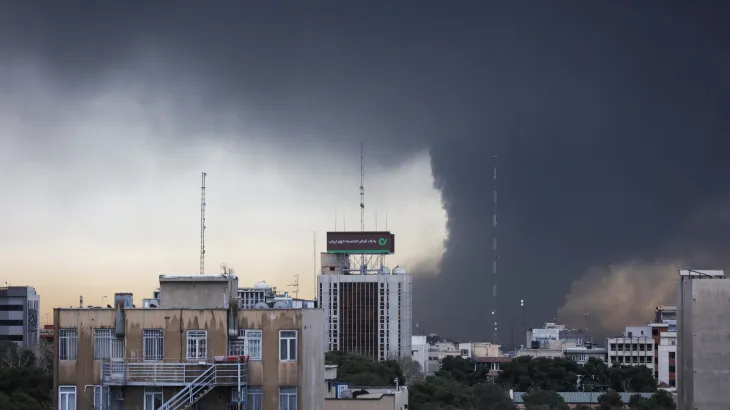
The Iran new supreme leader Tehran strikes crisis has deepened as Iranian clerics move closer to announcing the country’s next supreme leader while heavy smoke spreads across the capital after strikes on fuel depots.
Large fires erupted in several oil storage facilities near Tehran after attacks linked to the escalating conflict involving Iran and Israel. Residents reported thick black smoke drifting across the skyline, while authorities rushed to contain the fires and protect nearby neighborhoods.
At the same time, senior clerics within the country’s leadership body say they have already voted on a successor to replace the late Ali Khamenei, though officials have not yet publicly revealed the name.
The twin developments — leadership transition and intensifying strikes — mark one of the most volatile moments in Iran’s recent political history.
Explosions lit up parts of Tehran overnight after strikes targeted fuel storage facilities on the outskirts of the city. Fires burned through multiple storage tanks, sending towering columns of black smoke into the air.
Residents said the smoke covered large sections of the capital and could be seen from highways and residential districts. Emergency crews moved quickly to control the flames and prevent further damage.
Iranian officials strongly condemned the attacks. Government spokespersons argued that targeting fuel infrastructure releases toxic substances into the air and threatens civilian safety.
Authorities said the fires could worsen air pollution in a city already struggling with environmental challenges.
While the fires burned near Tehran, political developments accelerated behind closed doors. The powerful clerical body known as the Assembly of Experts met to select the country’s next supreme leader.
Members of the council confirmed that a vote had already taken place.
“The election for leadership has been completed and the leader has been chosen,” one senior cleric told Iranian media. Officials said the secretariat will announce the new leader soon.
The council traditionally chooses the supreme leader from among senior clerics who hold strong influence within Iran’s religious and political establishment.
Analysts believe several influential clerics could emerge as Iran’s next leader. One widely discussed figure is Mojtaba Khamenei, the son of the late supreme leader.
Mojtaba has long played a powerful behind-the-scenes role in Iran’s political network and maintains strong connections with the Islamic Revolutionary Guard Corps.
Some experts say choosing him could strengthen hard-line influence within the government. Others believe the Assembly of Experts might select a compromise figure to maintain stability during the conflict.
Until officials release the final decision, uncertainty continues to shape political calculations both inside and outside Iran.
The Iran new supreme leader Tehran strikes story unfolds against a wider regional conflict. Israeli forces have expanded their campaign against Iranian targets, including military facilities and infrastructure linked to missile production,
Iran has responded with missile and drone attacks across the region, targeting sites in several Middle Eastern countries. These exchanges have pushed the conflict beyond national borders and increased fears of a broader war.
Military analysts say strikes on oil infrastructure serve both strategic and symbolic purposes. Fuel depots often support logistics networks for armed forces, making them high-value targets during wartime.
Residents of Tehran now face rising uncertainty as smoke clouds hover over the city and the political future remains unclear.
Hospitals have reported an increase in respiratory complaints due to the smoke. Environmental specialists warn that burning petroleum products release toxic particles that can affect air quality for days.
City officials urged people to remain indoors and limit outdoor activity until authorities control the fires.
The government also stepped up security in sensitive areas, including government offices and communication infrastructure.
Governments across the world are closely monitoring the situation. Several international leaders have called for restraint and urged all sides to avoid further escalation.
Diplomatic observers say Iran’s leadership transition could influence the direction of the conflict. A new supreme leader may adopt either a hard-line approach or a strategy aimed at reducing tensions.
At the same time, the strikes on Tehran highlight how quickly regional conflicts can disrupt civilian life and political stability.
The coming announcement of Iran’s next supreme leader could shape the country’s future for decades. The position holds ultimate authority over the military, judiciary, and key state institutions.
At a time when Tehran faces both military pressure and domestic uncertainty, the leadership decision will carry enormous political weight.
For many Iranians, the immediate concern remains the smoke-filled skies and the growing fear that the conflict could intensify further.
As firefighters battle the flames and clerics finalize their decision, the Iran new supreme leader Tehran strikes crisis continues to evolve — with consequences that could reach far beyond Iran’s borders.