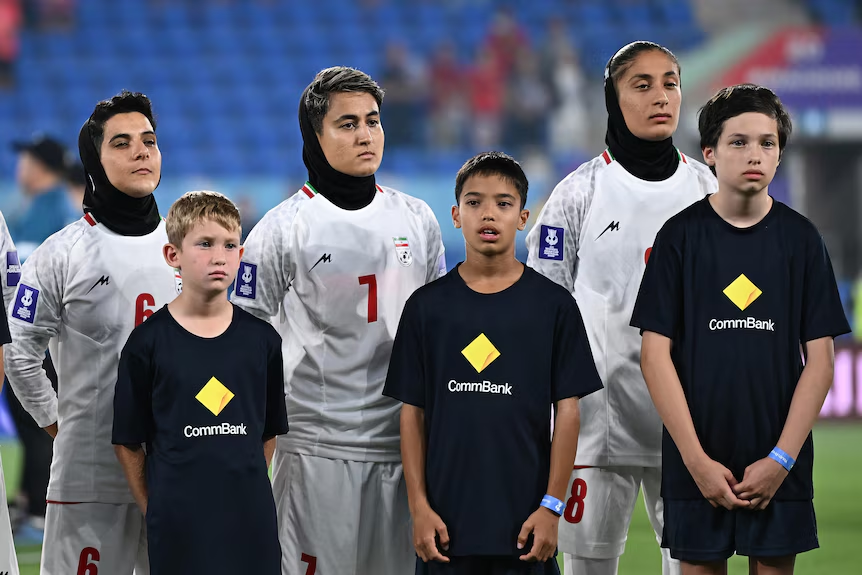
Five Iranian footballers in an Australian safe house have emerged as central figures in an international debate over athlete safety, human rights, and political expression. The women fled their team’s Gold Coast hotel following fears they could face punishment if forced to return to Iran after silently protesting their national anthem during the Women’s Asian Cup. The incident has ignited global discussion on asylum rights and the intersection of sport and politics.
The controversy began during the 2026 Women’s Asian Cup in Queensland, Australia, when players from Iran’s women’s national football team stood silently during the Iranian national anthem before their match against South Korea. This act was interpreted by many observers as a political protest against the Iranian regime, especially amid a broader conflict involving the country.
Iran’s state media responded by branding the players as “traitors” and “wartime traitors,” terms that carry heavy political implications in Iran and raised alarm among human rights advocates who feared severe repercussions for the players if they returned home.
Amid escalating safety concerns, five members of the team — Fatemeh Pasandideh, Zahra Ghanbari, Zahra Sarbali, Atefeh Ramazanzadeh and Mona Hamoudi — left their team hotel in the Gold Coast to seek refuge in Australia. According to multiple sources, the players are now under the protection of the Australian Federal Police and staying in a safe house while their asylum claims are processed.
The move came after the team was due to depart Australia following their 2–0 loss to the Philippines in the tournament, triggering heightened protests by supporters who surrounded the team bus chanting “Save our girls.”
The unfolding situation has sparked strong reactions internationally. Former U.S. President Donald Trump publicly urged Australian authorities to grant asylum to the players, warning that returning them to Iran could endanger their lives.
Human rights advocates and diaspora groups have also intensified their calls for legal protection and asylum pathways, drawing comparisons to Australia’s earlier support for the Afghan women’s soccer team in 2021.
Global player union FIFPRO is in communication with FIFA, the Asian Football Confederation (AFC), and Australian officials to ensure the team’s safety and provide clarity on their legal status.
Concerns for the players’ welfare are tied to broader issues of human rights in Iran, particularly amid conflict and state repression of protest movements. Experts fear that athletes who openly deviate from state expectations could be targeted for punishment, including imprisonment or worse.
These fears intensified after videos emerged showing one player appearing to make an international distress signal from a bus window as fans protested.
Under Australian law, individuals who fear persecution based on political expression may apply for refugee protection. The Department of Home Affairs is reportedly processing the players’ asylum claims as discussions continue behind the scenes.
Australian Home Affairs Minister Tony Burke is said to have engaged with the situation directly, although the government has been cautious in public comments, balancing diplomatic relations with Iran and international human rights obligations.
Back in Iran, state media’s condemnation has amplified local tensions. Apart from pressure to condemn the players, some Iranian commentators have demanded punitive action, framing the anthem protest as a serious offence.
Yet, in the Iranian diaspora and globally, supporters have rallied for the players’ courage and safety, urging international bodies to stand against repression and protect athletes’ rights to expression.
The incident now places spotlight on organizations like FIFA and AFC to address the intersection of sport and political expression. Advocates argue that international sporting bodies must do more to safeguard athletes who face threats due to peaceful protests or political dissent.