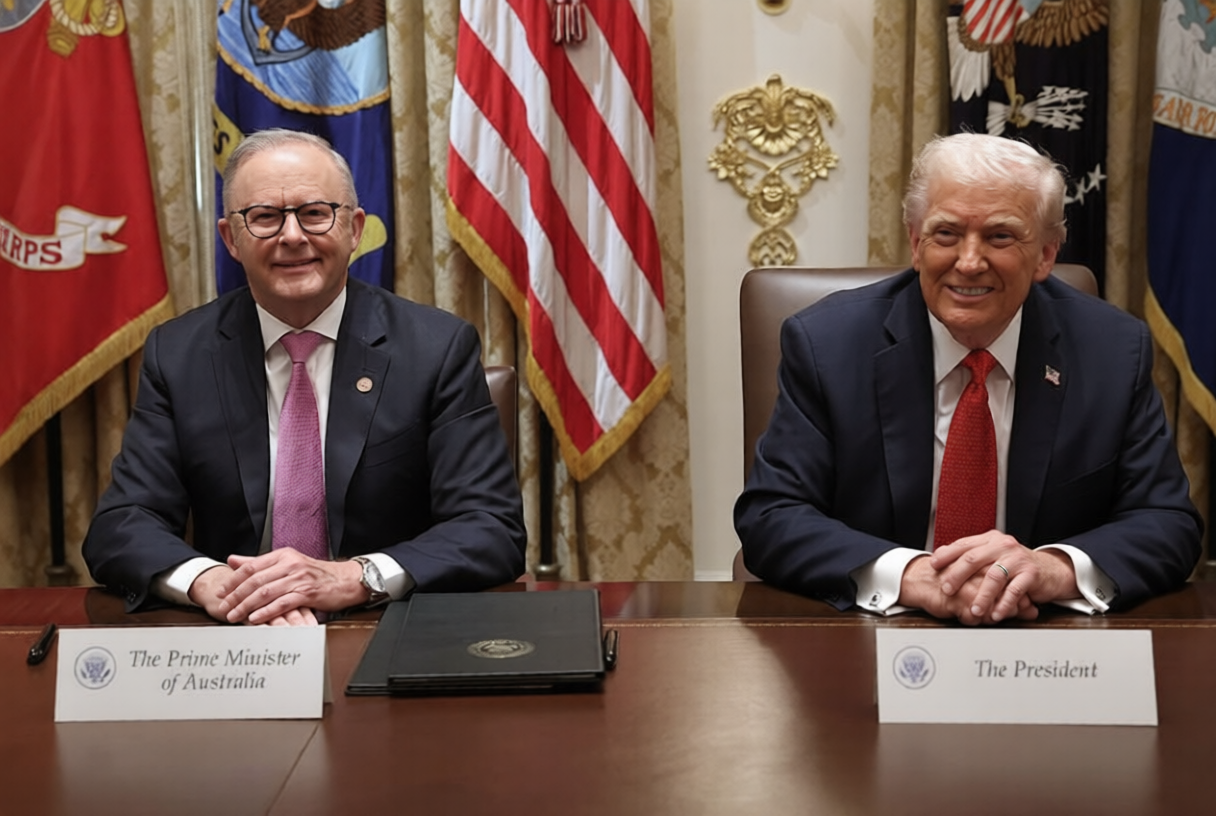
The diplomatic relationship between world leaders often extends beyond official talks and agreements. Symbolic gestures, including carefully chosen gifts, are commonly exchanged during state visits. One such gesture has recently drawn attention after it was revealed that Anthony Albanese presented a $3,000 pearl pendant to Melania Trump during a visit to the White House.
The gift, which was given during Albanese’s meeting with Donald Trump, has sparked interest in diplomatic traditions and the symbolic value of gifts exchanged between global leaders.
The details of the $3,000 pearl pendant for Melania Trump were disclosed through official documents obtained under a Freedom of Information request in Australia. According to the records, the jewelry was presented during Albanese’s October 2025 visit to Washington, D.C.
The elegant necklace, described as a Bianca pearl pendant, features a single pearl suspended from a gold chain. It was valued at approximately $2,980, excluding tax, according to government records.
The piece was reportedly sourced from Paspaley, a renowned Australian pearl jewelry company known for producing high-quality South Sea pearls.
Diplomatic gifts are commonly recorded and disclosed under transparency rules, particularly when they exceed certain monetary thresholds.
Gift-giving between world leaders is not merely ceremonial. In many cases, the gifts are carefully selected to represent the culture, craftsmanship, or heritage of the country presenting them.
In the case of the pearl pendant for Melania Trump, the choice appears to reflect Australia’s long-standing reputation for producing some of the world’s most valuable pearls.
Australian South Sea pearls are internationally recognized for their size, rarity, and lustre. By selecting such a piece, Albanese may have intended to highlight one of Australia’s most iconic luxury exports.
Diplomatic experts often note that gifts can carry subtle messages about respect, partnership, and goodwill between nations.
The pearl pendant was not the only gift presented during the visit. Reports indicate that Albanese also gifted Donald Trump a model of a Virginia-class nuclear submarine mounted on a gold-finished base.
The submarine model symbolized the strategic defense partnership between the United States and Australia, particularly within the framework of the AUKUS security agreement.
The AUKUS pact involves the transfer of nuclear-powered submarine technology to Australia and represents one of the most significant defense collaborations between the two countries.
The symbolic submarine gift therefore reflected the broader strategic relationship between Washington and Canberra.
Diplomatic exchanges are typically reciprocal, and this meeting was no exception. According to the documents, Donald Trump presented Albanese with a desk set with stationery bearing the presidential seal.
The desk set was valued at approximately $923, although it had reportedly been purchased for a lower price.
Under Australian government rules, gifts received by ministers above a certain value must be declared and often surrendered to the government for official use or display.
As a result, the desk set was later handed over to the Department of Prime Minister and Cabinet rather than kept as a personal item.
Many countries maintain strict transparency regulations regarding gifts received or given by public officials.
In Australia, members of parliament are required to declare gifts worth more than $750.
These disclosures ensure that government officials remain accountable and that expensive gifts are not interpreted as attempts to influence policy decisions.
In this case, the pearl pendant given to Melania Trump exceeded that threshold, which explains why it was documented in official records.
Such transparency measures are designed to maintain public trust and prevent conflicts of interest.
Political analysts believe that the gift exchange also formed part of a broader diplomatic strategy during Albanese’s meeting with Trump.
The visit occurred at a time when Australia was seeking continued U.S. support for the AUKUS defense pact.
By presenting symbolic gifts connected to Australian identity and strategic cooperation, Albanese may have aimed to reinforce the alliance between the two countries.
Diplomatic charm, including cultural gestures and thoughtful gifts, often plays an important role in international negotiations.
The exchange of gifts between political leaders has a long history. From historical artifacts to luxury items, these tokens are often intended to celebrate partnerships or commemorate major diplomatic milestones.
World leaders have previously given Trump a variety of symbolic gifts, including medals, artwork, and luxury items.
These gestures, while sometimes modest, are carefully curated to represent the presenting nation’s identity and values.
In this context, the pearl pendant given to Melania Trump fits into a broader tradition of symbolic diplomacy.
The revelation of the pearl pendant gift quickly attracted attention from international media outlets.
Some observers viewed the jewelry as a thoughtful representation of Australian craftsmanship, while others questioned whether expensive gifts are appropriate in diplomatic settings.
However, experts note that such gifts are relatively common in international politics, particularly during high-profile meetings between leaders.
As long as the exchanges are transparently documented and follow official guidelines, they are generally considered a normal part of diplomatic protocol.
In modern diplomacy, symbolism continues to play a powerful role alongside policy discussions.
A carefully chosen gift can convey respect, strengthen relationships, and reinforce shared interests between nations.
The $3,000 pearl pendant for Melania Trump may appear simple on the surface, but it represents a broader narrative about international diplomacy, cultural identity, and political partnerships.
For Australia and the United States, the exchange highlights a relationship built not only on strategic agreements but also on gestures of goodwill.