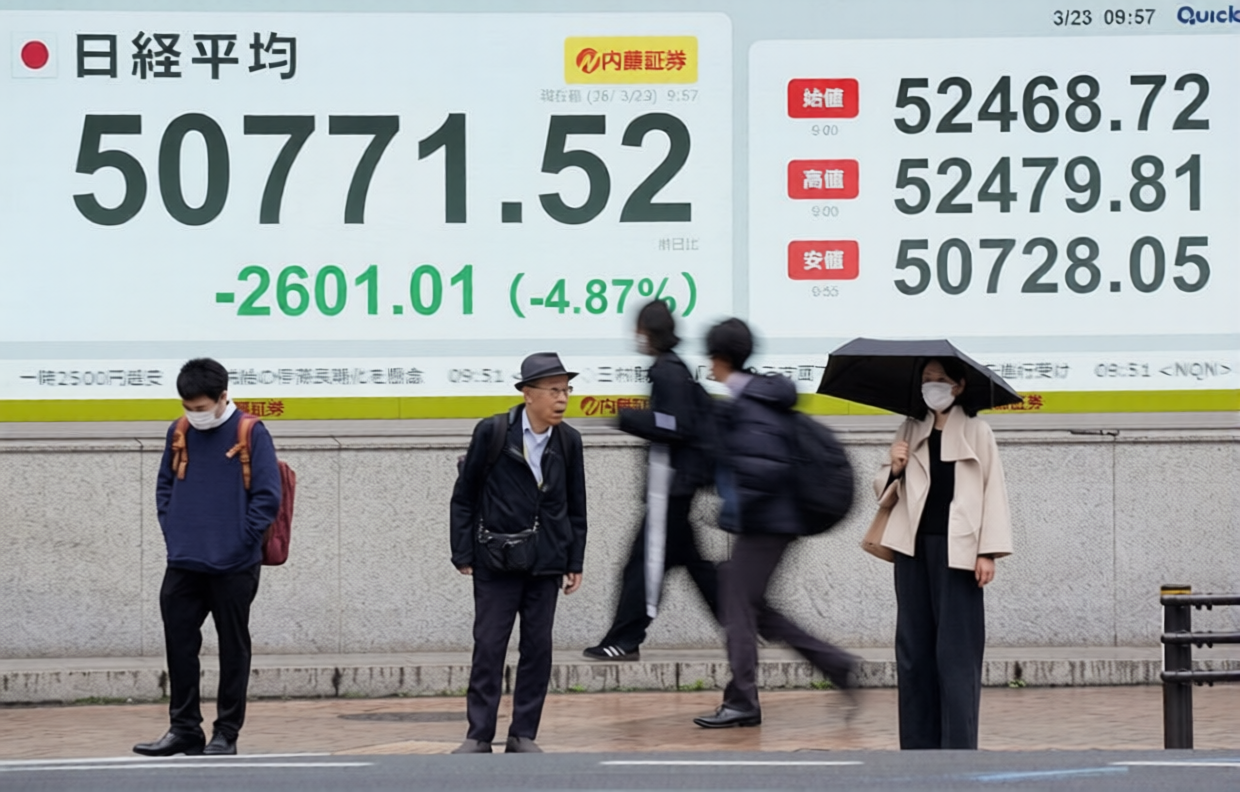
Asian stock markets opened the week under heavy pressure as fears of a prolonged conflict between the United States and Iran shook investor confidence. The phrase “Asia stocks slide US Iran war” now reflects the growing anxiety across global financial markets.
Major indices across the region recorded sharp losses. Japan’s Nikkei dropped nearly 4%, while South Korea’s KOSPI plunged over 5% in early trading. Other markets across China and the broader Asia-Pacific region also moved lower as investors rushed to reduce risk.
This sharp decline did not happen in isolation. It followed escalating threats between Washington and Tehran, which signaled that the conflict could intensify rather than cool down.
The main driver behind the market fall is uncertainty. Investors fear that the conflict could disrupt global energy supply and push inflation higher.
Iran has warned it could target energy infrastructure in the Gulf if tensions escalate further. At the same time, the US has demanded strategic concessions related to key oil shipping routes like the Strait of Hormuz.
This region is critical because nearly one-fifth of the world’s oil passes through it. Any disruption here immediately impacts global oil prices and economic stability.
As a result, investors are pulling money out of risky assets like stocks and moving toward safer options.
Oil prices have remained above $110 per barrel as the conflict continues. The rise in crude prices is one of the biggest reasons why Asia stocks slide US Iran war fears are intensifying globally.
Higher oil prices increase transportation and production costs. This leads to inflation, which affects both businesses and consumers.
Countries in Asia are especially vulnerable because many of them depend heavily on imported oil. Rising energy costs directly impact their economies, making investors even more cautious.
The impact is not limited to Asia. Global markets are also feeling the shock.
In India, stock markets crashed sharply, with the Sensex dropping more than 1,300 points and massive investor wealth wiped out in a single day.
At the same time, hedge funds have been rapidly selling Asian stocks, marking the largest sell-off in nearly a year.
This shows that institutional investors are losing confidence in short-term market stability.
Another key factor behind the downturn is the strengthening US dollar.
As uncertainty grows, investors often move their money into US assets, which are considered safer. This increases demand for the dollar and pushes its value higher.
At the same time, US bond yields have surged to multi-month highs.
Higher yields reduce the attractiveness of stocks because investors can earn better returns from safer government bonds.
The war is also affecting global supply chains. Shipping routes are under threat, and transportation costs are rising.
This creates a ripple effect across industries. From manufacturing to agriculture, businesses are facing higher costs.
Fertilizer prices and shipping expenses are already increasing, which could lead to higher food prices worldwide.
For developing economies, this situation is especially dangerous.
Market sentiment has clearly shifted toward caution.
Investors are now expecting:
- Slower global economic growth
- Higher inflation
- Possible interest rate hikes
This combination is toxic for stock markets.
Even sectors that performed well earlier in the year, like technology and semiconductors, are now facing selling pressure.
The future of global markets depends heavily on how the conflict evolves.
If tensions escalate further:
- Oil prices could rise even more
- Inflation may worsen
- Markets could fall deeper
However, if diplomatic solutions emerge, markets may stabilize quickly.
For now, uncertainty remains the biggest factor driving market behavior.
The keyword “Asia stocks slide US Iran war” is more than just a headline—it reflects a deeper global economic concern.
Markets are reacting not just to current events, but to what could happen next.
Investors hate uncertainty, and right now, uncertainty is everywhere—from oil supply to geopolitical stability.
Until there is clarity, volatility is likely to continue dominating global markets.