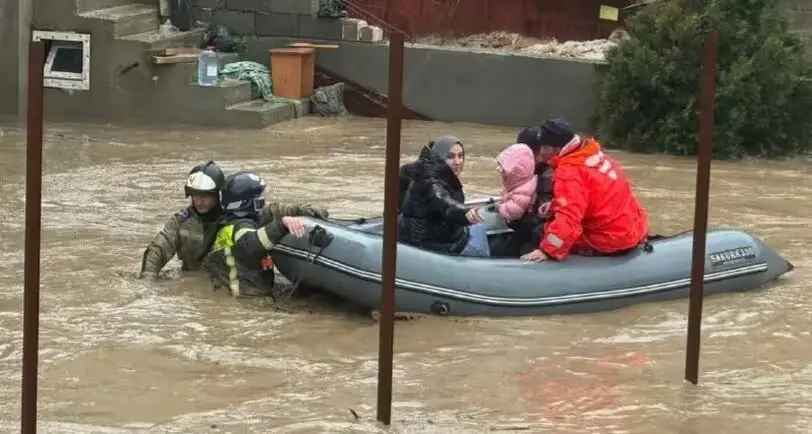
Russian authorities have declared a state of emergency in Makhachkala — the capital of the Republic of Dagestan — after days of relentless rainfall caused severe flooding and knocked out electricity for more than 327,000 people across the region. This dramatic situation is testing local infrastructure and emergency response efforts.
Heavy rainstorms that hit Dagestan — a republic in southern Russia along the Caspian Sea — overwhelmed drainage systems and low-lying areas, turning streets into rivers virtually overnight. As floodwaters surged, essential power lines and electrical infrastructure were damaged, leaving hundreds of thousands without electricity.
According to the regional emergency ministry, more than 327,000 residents — including nearly 90,000 children — are currently without power in over 280 towns and villages.
In response to this escalating crisis, local authorities in Makhachkala raised the alert level and officially declared a state of emergency, mobilizing emergency crews, rescue teams, and government support to assist residents.
Meteorologists reported persistent and heavy downpours across Dagestan in recent days. Though occasional rain is typical in the region, the intensity and volume of water far exceeded forecasting predictions, swelling rivers and flooding streets and homes.
Officials had anticipated some level of flooding and prepared basic mitigation measures. However, the sheer scale of the current event surpassed expectations, overwhelming infrastructure and leaving many communities vulnerable.
Dagestan — like many regions in Russia — has infrastructure that struggles under extreme conditions. Power grids in the area have faced periodic failures and overloads, especially during weather events. Past incidents showed that electrical networks here can falter when stressed, making communities more susceptible to outages.
When floodwaters destabilize ground support and substations, the risk of widespread blackouts increases substantially. In this latest crisis, that risk became reality, affecting hundreds of thousands.
Local residents spoke of harrowing nights without lights, communication interruptions, and ongoing uncertainty. Families were forced to rely on backup power, flashlights, and shared generators. In many areas, cell phone signals became sporadic as network towers attempted to operate on limited electricity.
Some neighborhoods reported flooding entering basements and ground-floor homes, forcing families to raise belongings and seek temporary shelter with neighbors or at designated emergency centers.
In response to the crisis, rescue workers and emergency services have been dispatched across flood-affected zones. Several municipal agencies are coordinating food, water, and medical support for displaced or isolated residents.
City administrators have also established information hotlines and shelters to provide safe refuge for families whose homes have been inundated or remain without power.
Meanwhile, engineers and technicians are working around the clock to repair damaged power infrastructure and restore electricity to affected communities.
Weather forecasts indicate that rainfall may continue throughout the weekend, presenting ongoing challenges to recovery efforts and raising the possibility of further flooding.
Authorities have urged residents to remain vigilant, avoid unnecessary travel, and follow instructions from emergency response teams. They also emphasize the importance of assisting vulnerable neighbors, especially children, the elderly, and those with mobility challenges.
This disaster in Dagestan is an example of how extreme weather can quickly transition from a forecasted disturbance to a major humanitarian and infrastructure crisis. It also highlights the vulnerabilities of aging utility systems that are not equipped to handle significant climate stress.
The impacts are not just physical — power outages disrupt communication, healthcare services, commerce, and daily routines, often leaving residents to face uncertainty and stress for extended periods.