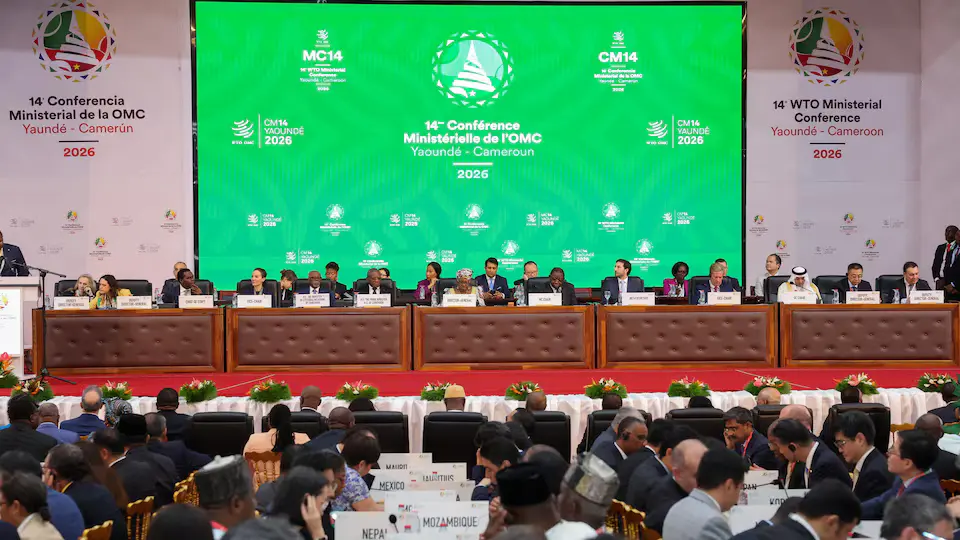
The latest round of WTO e-commerce talks has stalled, as disagreements between the United States and India continue to block progress. Negotiators entered the final day of discussions with little hope of reaching a consensus, highlighting deep divisions over the future of global digital trade.
For months, member countries have been trying to establish common rules for cross-border e-commerce. However, the ongoing deadlock between two major economies has slowed down the entire process.
The WTO e-commerce talks aim to create a global framework for digital trade. This includes rules on data flow, online consumer protection, and digital taxation.
Moreover, such agreements are crucial in today’s digital economy, where online transactions play a major role in global business. A successful deal could simplify trade and encourage innovation worldwide.
However, without agreement, countries may continue to follow different rules. As a result, businesses could face higher costs and uncertainty.
The main conflict lies between the United States and India. The U.S. supports free data flow across borders and limits on data localization requirements. In contrast, India wants stronger control over data generated within its borders.
Additionally, India has raised concerns about protecting its domestic digital economy. Officials argue that unrestricted data flow could disadvantage local companies.
On the other hand, the U.S. believes that fewer restrictions will promote innovation and benefit global tech companies.
Because of these opposing views, negotiations have reached a critical standstill.
The deadlock in WTO e-commerce talks could have significant consequences.
Firstly, it delays the creation of unified digital trade rules. This means companies operating internationally must adapt to different regulations in each country.
Secondly, smaller economies that rely on clear trade frameworks may struggle to compete. Therefore, the absence of agreement could widen the gap between developed and developing nations.
Furthermore, uncertainty in digital policies may discourage investment in emerging markets.
Many developing countries, including India, are calling for fairer digital trade rules. They argue that current proposals mainly benefit large tech companies from developed nations.
In addition, they want more flexibility to regulate their own digital markets. This includes the ability to impose taxes and protect local industries.
Consequently, the debate is not just about trade, but also about economic sovereignty and long-term development.
As WTO talks approach their conclusion, there is still a possibility of partial agreements. However, a comprehensive deal now seems unlikely.
Negotiators may continue discussions in future rounds. Meanwhile, countries could pursue regional or bilateral agreements instead of waiting for a global solution.
Even so, experts warn that fragmentation in digital trade rules could create long-term challenges for the global economy.
Trade analysts suggest that resolving the U.S.-India dispute will be key to any future progress.
Some experts believe compromise is possible if both sides adjust their positions. For instance, limited data flow rules combined with safeguards for developing countries could offer a balanced solution.
Nevertheless, reaching such a compromise will require strong political will and mutual trust.
The WTO e-commerce talks represent a turning point in global trade policy. While the current deadlock highlights serious disagreements, it also shows how important digital trade has become.
Therefore, finding common ground is essential. Without it, the world risks entering a fragmented digital economy where rules vary widely across borders.
For now, all eyes remain on future negotiations, as countries attempt to bridge the gap and shape the future of global e-commerce.