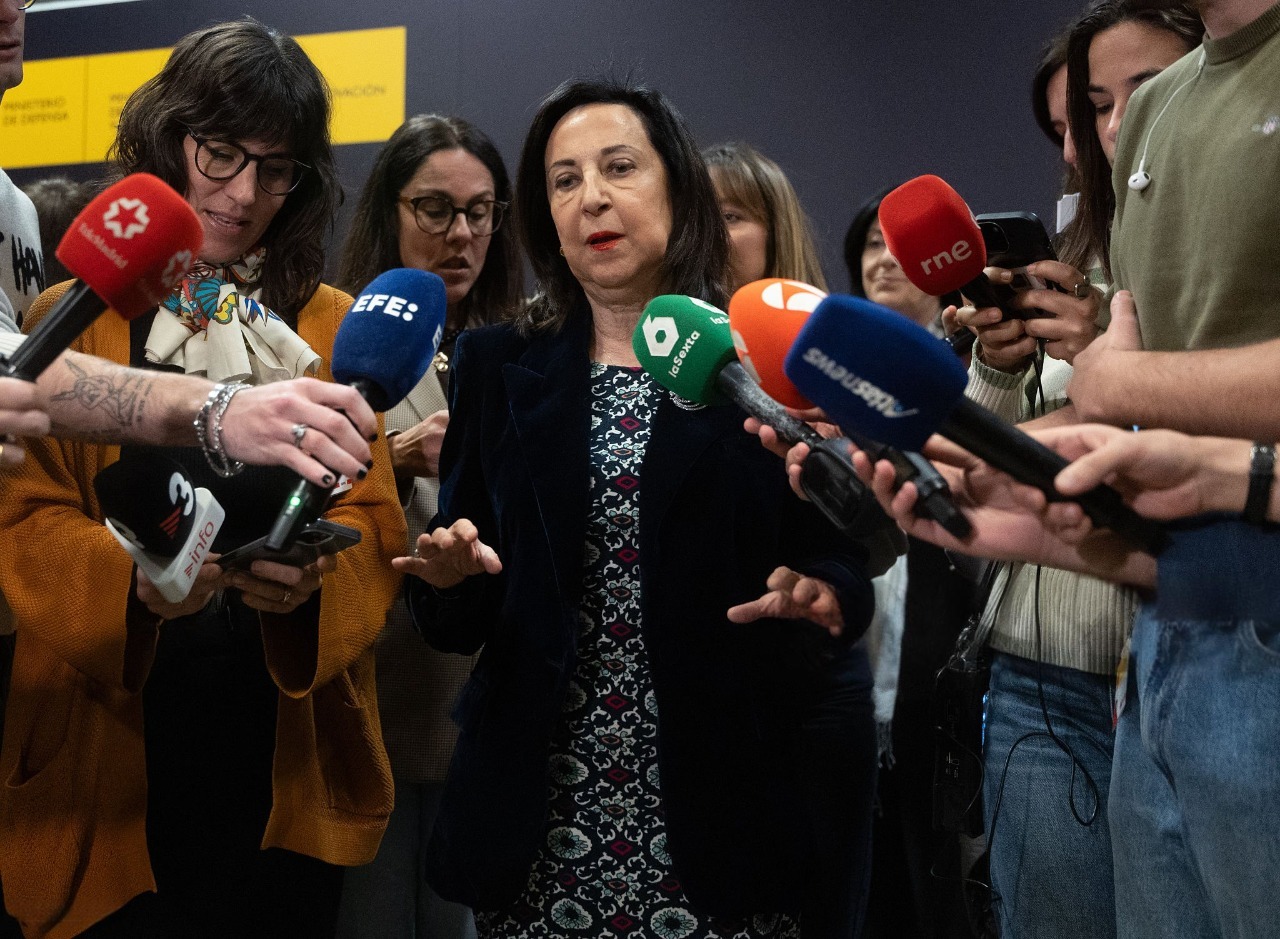
Spain has officially closed its airspace to U.S. military aircraft involved in the Iran war, a decision confirmed by Defence Minister Margarita Robles.
Spain has taken a dramatic and unprecedented diplomatic step by officially closing its airspace to U.S. military aircraft involved in the Iran war, a move that underscores Madrid’s deepening opposition to the conflict and signals a major rift with Washington.
This decision, confirmed by Defence Minister Margarita Robles, expands on Spain’s earlier refusal to grant Washington access to jointly operated military bases for operations linked to the conflict and marks one of the most significant European challenges to U.S. military strategy since the war began.
In official remarks, Spain’s government explained that it would no longer allow U.S. military flights connected with attacks on Iran to traverse or use Spanish airspace — effectively closing a strategic corridor for America’s war operations.
Economy Minister Carlos Cuerpo clarified in an interview that the move is part of Spain’s broader policy not to participate in or contribute to what it views as a war initiated “unilaterally” and in violation of international law.
Prime Minister Pedro Sánchez has repeatedly condemned the U.S. and Israeli airstrikes on Iran as “reckless, illegal, and unjust,” arguing that Spain cannot be complicit in a conflict that jeopardizes civilian lives and global stability.
This stance represents a rare and bold departure from typical NATO unity — especially toward the United States — and underscores the Spanish government’s commitment to upholding what it sees as international legal standards.
Under the new directive:
- All U.S. military flights involved in operations targeting Iran must avoid Spanish airspace.
- Military aircraft routed toward the Middle East from Europe will now be forced to reroute around Spain.
- The restriction applies even to aircraft transiting internationally, except in emergencies, where humanitarian or distress situations may still be granted access.
For U.S. forces, this poses logistical and strategic hurdles. Spain’s position comes at a time when European airspace is critical to the coordination of long‑range operations, making Madrid’s decision notable both practically and symbolically.
Spain has been one of the most outspoken opponents of the Iran war within Europe. Even before the airspace closure, Madrid had refused to authorize the use of critical military bases — including Rota and Morón — for war operations launched by the United States and Israel.
Earlier in March, at least fifteen U.S. military aircraft were repositioned from Spanish bases to locations in Germany and France after Spain denied their use in strikes against Iran. That decision, rooted in legal and moral opposition to the war, already strained diplomatic ties between Madrid and Washington.
These moves marked Spain as Europe’s leading government pushing back against the U.S.-initiated conflict, openly embracing a stance that many allies hesitated to take publicly.
Unsurprisingly, Washington has reacted with concern to Spain’s latest move. According to local reports, U.S. President Donald Trump has threatened trade repercussions against Spain, warning that continued resistance could impact economic ties.
This confrontation represents one of the most severe diplomatic strains between the two NATO partners in decades. Traditionally closely aligned on defense and security matters, the U.S. and Spain now find themselves sharply at odds — not only in policy but in interpreting international law and national priorities.
Spanish officials, however, remain resolute. They argue that solidarity with the principles of peace and lawful conflict resolution outweighs strategic cooperation with the U.S. military in a conflict many Spaniards view as unnecessary and harmful.
Spain’s decision has resonated far beyond Europe, prompting world leaders, analysts, and ordinary citizens to re‑evaluate international alliances and the balance between military partnerships and ethical constraints.
Human rights organizations and foreign policy experts have lauded Madrid’s move as a principled stand — especially amid widespread criticism of ongoing violence in the Middle East and growing civilian casualties. Critics, however, argue that closing airspace to allied military support may weaken collective security mechanisms and embolden adversaries.
Meanwhile, countries across the European Union are watching Spain closely. To date, no member state has adopted a similarly hard line, but Spain’s stance may inspire renewed debate about how far European nations are willing to go in shaping independent foreign policy decisions.
Spain’s closure of its airspace to U.S. military aircraft involved in Iran war operations represents a bold political and diplomatic act that could reshape alliances, challenge traditional defense cooperation frameworks, and ignite broader discussions about international law and moral responsibility in conflict.
As the war continues, Spain’s position underscores a growing rift between major world powers and raises critical questions about the future direction of global diplomacy.