U.S. rescue teams are facing a harrowing and dangerous search for a missing F‑15 crew member in Iran, in what has become one of the most precarious search‑and‑rescue operations of the ongoing conflict. This mission comes after an American fighter jet was shot down over Iranian territory, and while one crew member was successfully rescued, the fate of the second remains unknown.
The situation underscores the dangerous conditions on the ground, the complexity of retrieving service members in hostile territory, and the wider geopolitical tensions simmering between the United States and Iran.
On Friday, April 3, 2026, a United States Air Force F‑15E Strike Eagle was shot down over southwestern Iran in the nation’s Kohgiluyeh and Boyer‑Ahmad province, marking the first time an American crewed aircraft has gone down inside Iranian territory during the current war.
The F‑15E is a two‑seat combat aircraft that normally carries a pilot and a weapons‑systems officer. Both crew members ejected following the attack on the jet.
While one crew member was rescued by U.S. special forces and is now receiving medical care, the other remains unaccounted for, which triggered an urgent search and rescue mission deep inside hostile territory.
Modern Combat Search‑And‑Rescue (CSAR) Under Fire
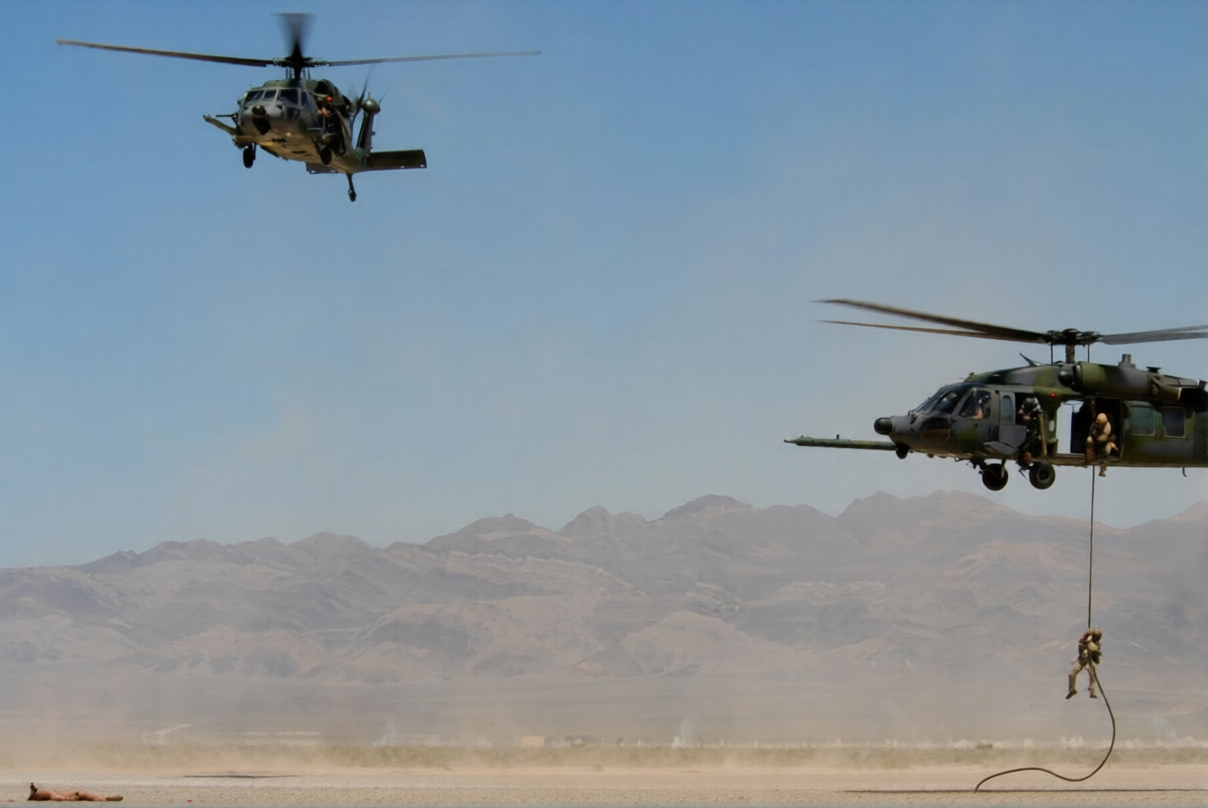
Search and rescue teams deployed a combined effort of helicopters, refueling aircraft, and reconnaissance planes to locate the missing airman. These helicopter crews are among the most highly trained in the world for situations that involve hostile fire and enemy resistance.
However, the terrain is rugged and unforgiving — steep mountains, deep valleys, and dense forests — making navigation and visibility extremely challenging. Search‑and‑rescue units risk being targeted by ground fire and anti‑aircraft systems while flying at low altitudes.
Moreover, two U.S. Black Hawk helicopters involved in the rescue mission were struck by enemy fire. Though they managed to exit Iranian airspace and landed safely, some crew members were injured during the incident.
Local Hostile Forces and Terrain
Iran’s Revolutionary Guard, local militias, and air defense units are actively involved in both defending their territory and searching for the downed American airman. In some regions, Iranian state media has even encouraged civilians to capture or assist in locating the missing crew member, complicating the rescue mission further.
This creates a duel — U.S. forces racing against Iranian units for recovery — heightening the risk that the missing crew member could be captured or face additional danger before help arrives.
Strategic Implications
The downing of the F‑15E and the subsequent rescue operation have major implications:
- Political blowback: Officials in Tehran have mocked U.S. efforts publicly, fueling propaganda efforts against Washington.
- International tensions: The incident disrupts diplomatic conversations and raises questions about the viability of de‑escalation talks.
- Military morale: Recovering personnel is historically a top priority for the U.S. military, and failure to do so could impact troop morale and domestic opinion.
White House press secretary Karoline Leavitt confirmed that President Donald Trump has been briefed on the rescue efforts, though official details remain limited. U.S. Central Command and the Pentagon have not publicly released identities or specific locations due to operational security concerns.
U.S. military leadership stressed that combat search‑and‑rescue operations are among the most complex missions carried out during wartime, highlighting the use of specialized helicopter crews and real‑time intelligence to find and extract personnel safely.
Iran’s state media has touted the incident as a significant achievement, releasing images that purport to show wreckage and debris from the downed aircraft. Tehran has also suggested rewards for civilians who assist in locating the missing airman.
The incident has drawn international concern, with NATO allies and regional partners urging restraint while emphasizing the importance of recovering missing service members without further escalation.
The harrowing and dangerous search for the missing U.S. crew member in Iran has swiftly become a defining moment in the conflict — not just for its military stakes, but for its intense human dimension. Families, fellow service members, and global audiences are watching closely as rescue teams push through hostile terrain under fire to bring one of their own home.
This ongoing story illustrates the unpredictable, fast‑changing nature of modern conflict — and the immense challenges faced when locating and rescuing personnel in enemy territory.