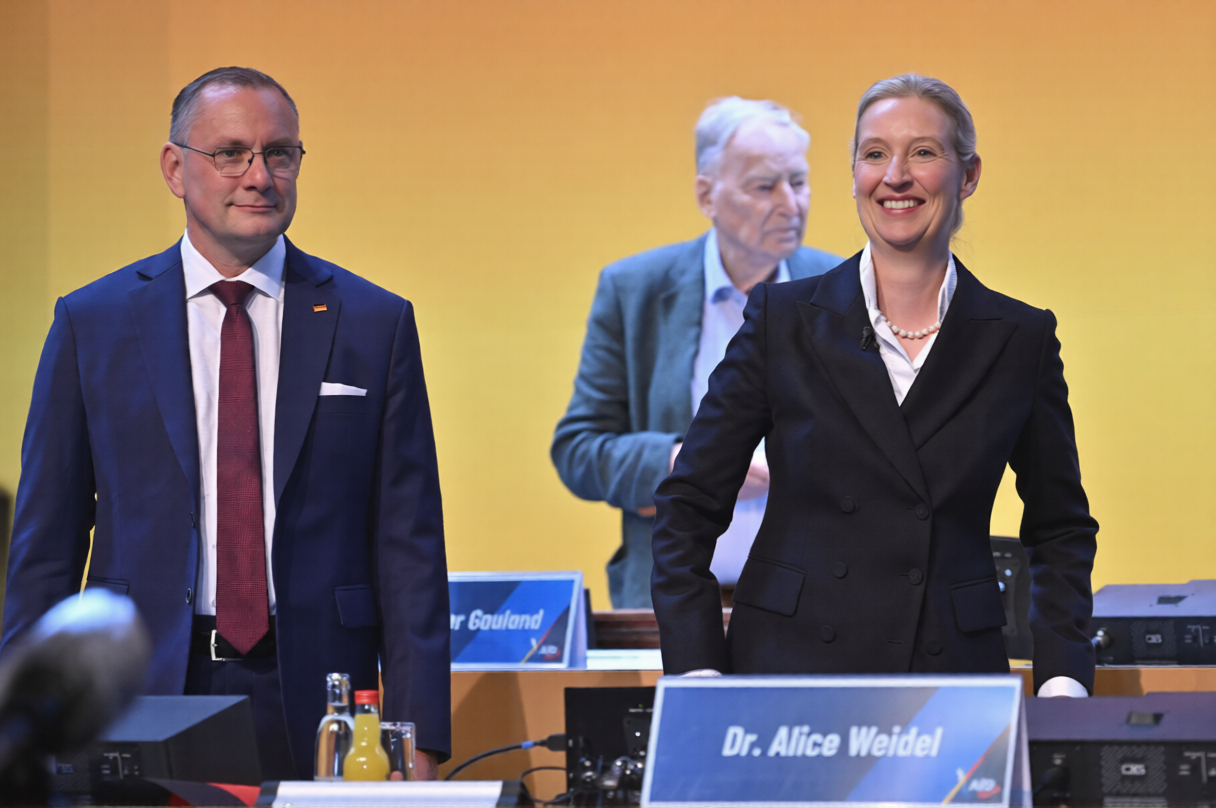
Germany’s far-right Alternative for Germany (AfD) has re-elected its co-leaders, Alice Weidel and Tino Chrupalla, during a high-profile party conference in the eastern city of Erfurt. The event unfolded amid massive demonstrations, with thousands of protesters taking to the streets and several confrontations breaking out between activists and police.
The two-day conference attracted nationwide attention as supporters celebrated the party’s continued rise in German politics while opponents accused it of promoting extremist and anti-democratic ideas. Heavy security measures were introduced across Erfurt, with police deployed from multiple regions to maintain order and protect delegates attending the gathering.
Alice Weidel and Tino Chrupalla received overwhelming backing from party delegates, extending their leadership of the AfD. Under their leadership, the party has transformed from a protest movement into Germany’s strongest opposition force and has recently climbed to the top of several national opinion polls.
Speaking after the vote, party leaders described the result as a mandate to continue expanding the party’s influence ahead of upcoming regional elections. They argued that increasing public dissatisfaction over immigration, inflation, and economic challenges has strengthened support for AfD across the country.
Party officials also stressed their intention to challenge Germany’s traditional political establishment, insisting that voters are seeking alternatives to the current governing coalition.
Outside the conference venue, thousands of demonstrators gathered throughout the day to protest against the party’s policies and growing popularity.
Trade unions, civil society organizations, student groups, and left-leaning political movements organized coordinated demonstrations across Erfurt. Protesters carried banners criticizing AfD’s immigration policies and warning against what they described as rising extremism in German politics.
Many activists attempted to block roads leading to the conference center by staging peaceful sit-ins and human blockades. Police responded by removing demonstrators from several access routes to allow delegates to enter the venue.
Authorities estimated that approximately 15,000 people participated in demonstrations, while other organizers claimed significantly higher attendance figures.
German police mounted one of the largest security operations seen in Erfurt in recent years.
Hundreds of officers wearing riot gear monitored demonstrations throughout the city as authorities sought to prevent disruptions to the conference. While most protests remained peaceful, isolated clashes occurred after some demonstrators attempted to block highways and entrances leading to the venue.
Several protesters were removed by police, and authorities reported numerous minor offenses including vandalism and obstruction. Despite the disruptions, delegates were ultimately able to reach the conference, allowing proceedings to begin largely as scheduled.
Officials urged both protesters and party supporters to remain peaceful and avoid escalating tensions.
The conference highlighted the AfD’s growing influence within German politics.
The party finished second in Germany’s 2025 federal election and has continued gaining support, particularly in eastern German states where concerns over immigration and economic uncertainty remain significant political issues.
Polls suggest AfD could perform strongly in upcoming state elections, especially in Saxony-Anhalt and other eastern regions. Although mainstream political parties continue to reject cooperation with AfD under Germany’s so-called “firewall” policy, analysts say its electoral momentum is becoming increasingly difficult to ignore.
Supporters view the party as a voice for stricter immigration controls and national sovereignty, while critics argue that some of its rhetoric threatens democratic values and social cohesion.
The timing of the conference added to the controversy, with critics pointing to historical sensitivities surrounding the location and date of the gathering.
Meanwhile, AfD leaders rejected accusations of extremism and described the demonstrations as politically motivated attempts to silence opposition voices. They argued that every democratic party has the right to organize public meetings without intimidation.
Germany’s domestic intelligence agency has previously classified AfD as a right-wing extremist organization, although that designation is currently suspended pending legal proceedings. The issue remains one of the country’s most politically sensitive debates.
With Alice Weidel and Tino Chrupalla remaining in charge, AfD now turns its attention toward upcoming regional elections that could reshape Germany’s political landscape.
Political analysts believe the party’s performance in eastern Germany will serve as a key test of whether its recent rise in national polling can translate into governing power at the state level. At the same time, continued public protests demonstrate that the party remains one of the most divisive forces in German politics.
As Germany prepares for another election cycle, the clash between growing support for AfD and strong public opposition is likely to remain at the center of the country’s political debate.