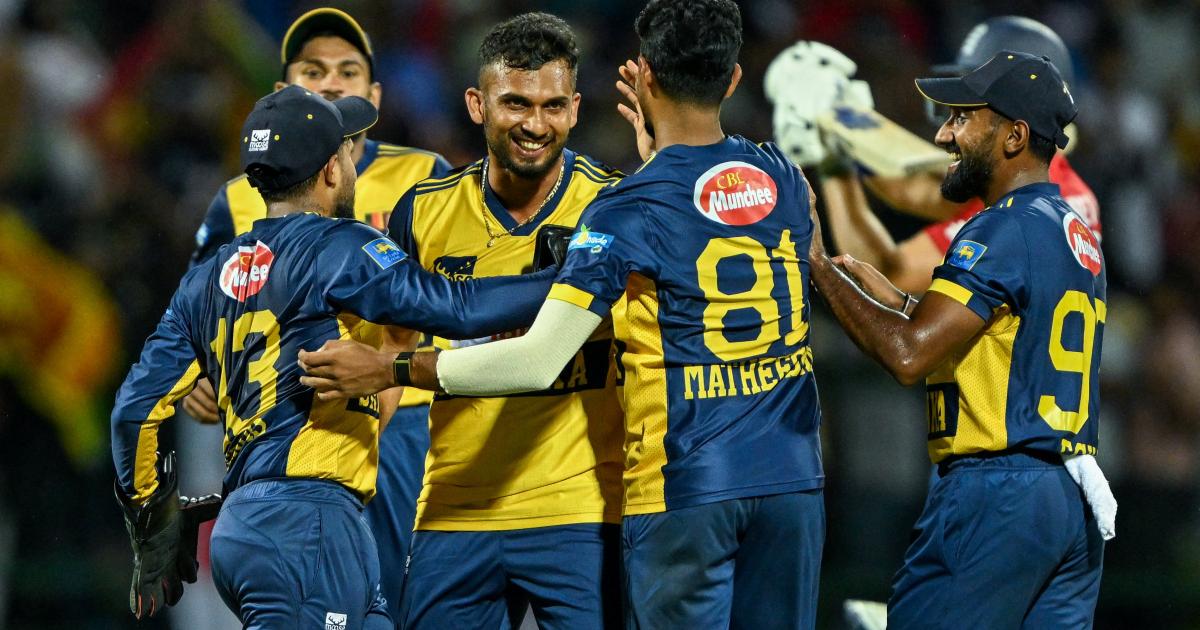
Sri Lanka began their ICC Men’s T20 World Cup 2026 campaign in confident fashion, defeating Ireland by 20 runs in a Group B match on Sunday at the R. Premadasa Stadium in Colombo. The hosts overcame early batting struggles and then used incisive spin bowling to restrict Ireland, crafting a strong platform for the rest of their tournament.
Opting to bat first after Ireland’s captain won the toss, Sri Lanka faced initial setbacks against disciplined Irish bowling before staging a late recovery that proved decisive.
Sri Lanka’s innings did not start smoothly. The opening pair struggled against accurate bowling from Ireland’s seam attack, with Pathum Nissanka (24 off 23 balls) and Kamil Mishara (14 off 11) falling early. The hosts found themselves on the back foot at 86 for four in the 14th over.
At this point, veteran wicketkeeper-batter Kusal Mendis took control. He anchored the innings with a composed half-century, finishing unbeaten on 56 off 43 balls, while rotating the strike and finding gaps rather than always looking for big hits.
The turning moment came when Kamindu Mendis entered the attack. The all-rounder produced a blistering cameo, smashing 44 runs off just 19 balls with four fours and two sixes, injecting crucial momentum into Sri Lanka’s innings. His aggressive assault in the late overs lifted the total to 163 for 6 in 20 overs—a figure that looked competitive on a pitch that slowed as the game progressed.
Sri Lanka’s ability to recover from a mid-innings wobble demonstrated their depth and experience, especially in high-pressure scenarios such as a World Cup opener.
Ireland’s bowlers struck early and often, with left-arm spinner George Dockrell continuing his strong form with figures of 2 for 17. Fast bowler Barry McCarthy also chipped in with 2 for 40, applying pressure during the middle overs.
Despite the quality of Ireland’s attack, dropped catches and missed opportunities proved costly at key moments. These lapses allowed Kusal and Kamindu Mendis to rebuild and accelerate, ultimately setting Ireland a challenging total.
Chasing 164, Ireland began positively. Harry Tector provided resistance at the top with a measured 40 off 34 balls, while Ross Adair contributed 34 off 23 balls. The pair resuscitated Ireland’s hopes after early hiccups, putting on a 49-run partnership for the third wicket.
Ireland captain Paul Stirling said his side aimed to build partnerships and keep the run rate under control, but the middle order faltered against Sri Lanka’s spin attack.
Sri Lanka’s spin bowling unit delivered the defining impact. Maheesh Theekshana was the standout bowler, finishing with 3 for 23, while Wanindu Hasaranga also claimed 3 for 25. Their combined effort dismantled Ireland’s momentum, triggering a collapse that saw the visitors lose wickets in quick succession.
Matheesha Pathirana contributed with vital breakthroughs too, taking 2 wickets in the final over to ensure Ireland were dismissed for 143 in 19.5 overs—20 runs short of Sri Lanka’s total.
Ireland’s chase showed promise early on, but the loss of Theekshana’s key wickets saw the required run rate climb and pressure mount. Fielding lapses, including dropped chances, further tilted the match in Sri Lanka’s favour as opportunities slipped through Ireland’s hands.
Despite spirited efforts from Tector and Adair, Ireland were unable to recover from the momentum shift caused by Sri Lanka’s spinners.
The accolade for Player of the Match went to Kamindu Mendis for his explosive 44-run cameo that powered Sri Lanka’s innings when it looked in danger of stagnating. His short but impactful blitz shifted the momentum at a crucial moment.
Theekshana and Hasaranga’s dual three-wicket hauls underscored how spin continues to play a decisive role in subcontinental conditions, especially at the iconic R. Premadasa Stadium.
This victory gives Sri Lanka a valuable early boost in Group B of the T20 World Cup, reinforcing their credentials as co-hosts and contenders. The win also sends a statement about their ability to fight back under pressure and defend totals with a balanced bowling attack.
For Ireland, the loss highlights areas to address ahead of forthcoming matches—particularly middle-over batting resilience and fielding discipline against spin bowling. Players and coaching staff will likely focus on converting starts into bigger scores in future games.
Sri Lanka now look ahead to their next Group B fixtures with confidence, aiming to build on this positive start and refine tactical approaches against diverse bowling attacks.
Ireland will regroup and aim to analyse their performance, looking to adapt their strategy to handle spin more effectively and build more substantial partnerships.
Both teams will continue their World Cup journey knowing that early results can shape momentum in a tournament where every match can be critical for qualification and knockout aspirations.