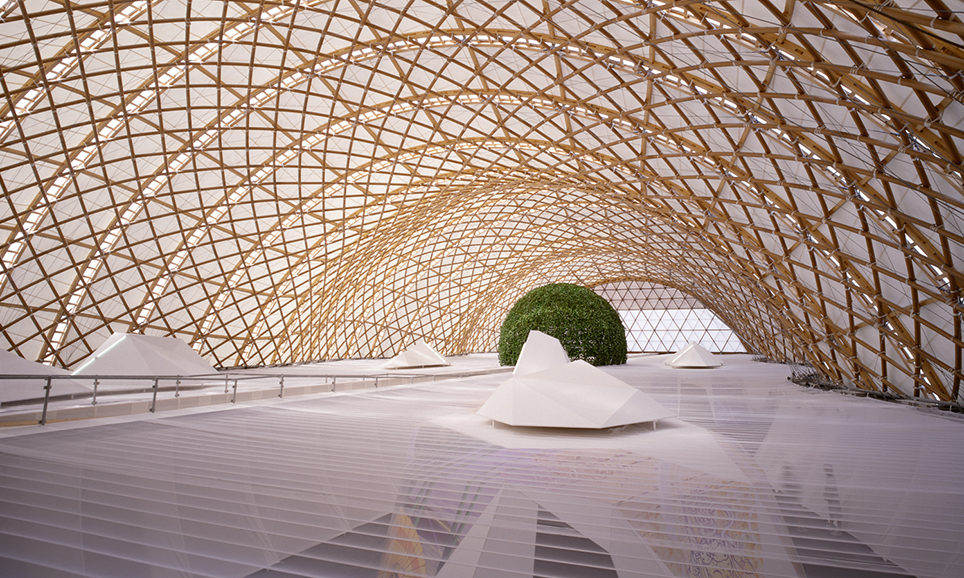
The Japanese architect uses cardboard, paper tubes and recycled materials to build cathedrals, shelters and humanitarian structures around the world.
Japanese architect Shigeru Ban has become a leading figure in sustainable and humanitarian architecture by transforming everyday materials like cardboard tubes, beer crates and paper into resilient buildings. His work challenges traditional construction ideas and offers new ways to respond to disaster and crisis with dignity and beauty.
Ban’s approach goes beyond aesthetics. He believes architecture should serve people, especially those affected by natural disasters and conflict. His creations range from luxury boutiques and museums to emergency shelters and sacred spaces where communities can gather after trauma.
Ban’s signature material is cardboard tubes, often reinforced with laminated timber or other supports but still anchored in recycled waste. These tubes are surprisingly strong and versatile. They’ve been tested in earthquake-prone regions and used to create both temporary and longer-lasting structures.
“I don’t like waste,” Ban has said, capturing the core of his philosophy. He transforms materials that others might discard into buildings that can shelter people, uplift spirits and spark community pride. His work has evolved from the mid-1980s onward, long before eco-design became fashionable.
One of Ban’s most celebrated creations is the Cardboard Cathedral in Christchurch, New Zealand. Built after the 2011 earthquake that devastated the city, the cathedral was designed as a temporary replacement for the damaged Anglican church.
The building uses dozens of cardboard tubes arranged in an A-frame structure that allows light to filter into the interior. Despite its humble materials, the cathedral was built to meet stringent safety and earthquake standards. It became a source of community resilience and hope after a major natural disaster.
Other examples include the Paper Dome built after the 1995 Kobe earthquake in Japan. Originally intended as a temporary replacement for a destroyed church, it became a popular community centre for years before being relocated to Taiwan.
Ban’s contributions extend well beyond religious spaces. After the 1994 genocide in Rwanda, he proposed using cardboard tubes to build low-cost shelters for refugees. The idea quickly gained support, and Ban became a consultant to the United Nations High Commissioner for Refugees (UNHCR).
He has also designed modular houses and partition systems that provide privacy and comfort to displaced families in disaster relief halls and camps. These systems help preserve basic human rights like personal space, even in emergency settings.
His Voluntary Architects’ Network (VAN), an NGO he founded, continues to develop building solutions for displaced and vulnerable communities worldwide.
Ban’s work draws from both Japanese architectural heritage and Western modernism. Traditional elements like paper screens inspired his early experiments with recycled paper, even as he pushed the material to new structural uses.
He has also applied his inventive style to projects outside humanitarian work, including luxury boutiques in Tokyo’s Ginza district, art installations in Aspen, Colorado, and museum spaces with distinctive shapes and materials in France.
His ability to move seamlessly between emergency shelters and high-profile architectural commissions reflects a unique vision: powerful design doesn’t have to be expensive or exclusive.
In 2026, Ban received the American Institute of Architects (AIA) Gold Medal, a prestigious honor recognising his contributions to architecture and humanitarian design. He was also invited to speak at major international forums, including a lecture at the Royal Geographical Society in London.
Currently, Ban is involved in post-earthquake reconstruction projects in Japan’s Noto Peninsula, where recycled timber from Expo installations is being repurposed to build housing. This underscores his lifelong commitment to reducing waste and supporting communities.
He is also engaged in designing a new hospital in Lviv, Ukraine, using locally sourced laminated wood to create functional, earthquake-aware medical infrastructure.
Ban’s work illustrates a powerful idea: materials often dismissed as weak can produce structures that are resilient, meaningful and sustainable. As he puts it, the strength of a building has “little to do with the strength of its materials.”
His buildings challenge assumptions about permanence and impermanence. In bustling cities like Tokyo or Los Angeles, skyscrapers can vanish. Yet a structure made with care and purpose — even from cardboard — can endure in memory and function.
For Ban, architecture is not merely about aesthetics. It’s about responding to human needs, especially after catastrophe, and about respecting the earth’s finite resources. His life’s work offers a blueprint for design that is both poetic and practical.