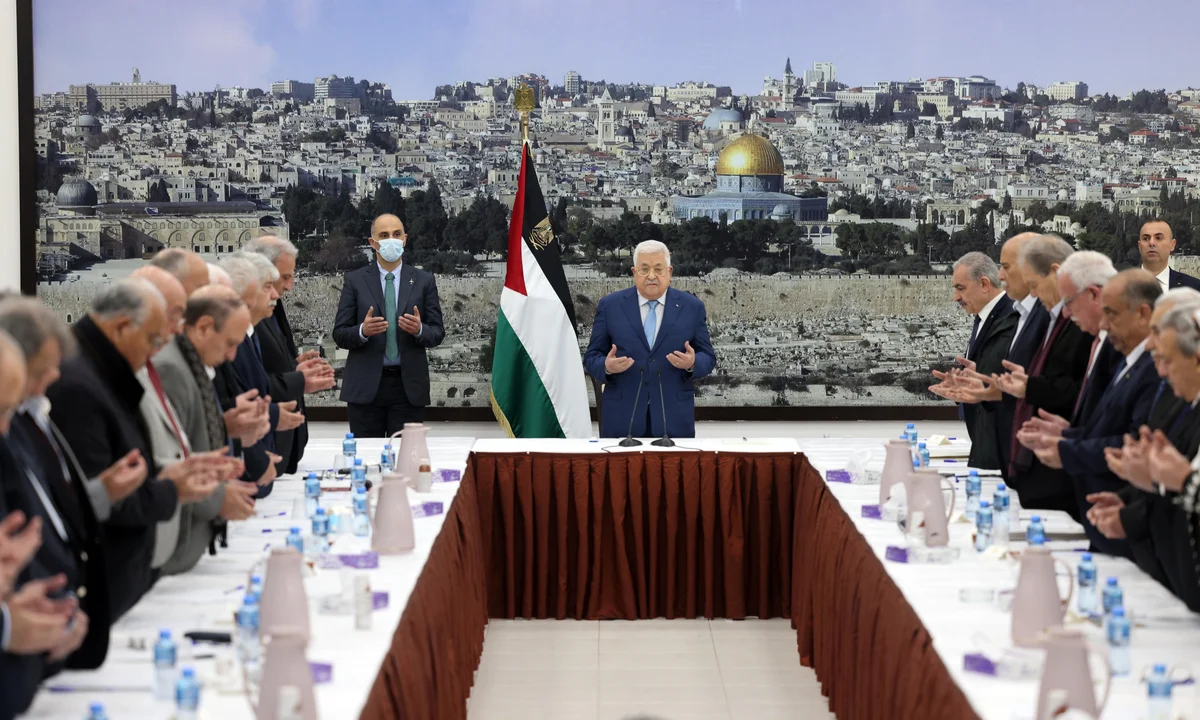
Palestinian Authority in Dire Straits as Israel’s Grip on West Bank Intensifies, Challenging Governance and Future of Two‑State Solution.
The Palestinian Authority (PA) is facing one of its most severe political and economic crises in decades as Israel intensifies its control over the occupied West Bank, undermining Palestinian self‑rule and deepening tensions across the region. What was once a limited autonomous governing body within parts of the West Bank now struggles to maintain basic services, financial stability, and political legitimacy — all while Israel advances policies that critics say edge closer to de facto annexation of the territory.
For years, the PA has controlled certain areas of the West Bank under agreements from the 1990s Oslo Accords, which envisioned eventual Palestinian statehood alongside Israel. But recent developments suggest that vision is eroding as Israel strengthens its hold, not only in areas already under full military control, but also through legal, economic, and administrative shifts that weaken both the PA’s authority and the feasibility of a sovereign Palestinian state.
In February 2026, Israel’s cabinet approved a suite of measures widely seen as expanding its administrative and legal reach across the West Bank. These include resuming land registration processes, removing restrictions on land transactions for Jewish settlers, extending Israeli planning and enforcement authority into areas traditionally under Palestinian administration, and reallocating land‑related powers from Palestinian municipal bodies to Israeli civil institutions. Palestinians and international critics describe these moves as a “de facto annexation” that further marginalizes the PA’s role.
The decision to restart land registration has drawn global concern, with critics warning it could dispossess Palestinian landowners by imposing stringent ownership requirements that few can meet, effectively transferring large tracts of territory into Israeli‑aligned control. Estimates from watchdog groups suggest that this could affect nearly half of the West Bank’s land, significantly altering demographic and political realities on the ground.
International bodies, including the United Nations, have voiced alarm over these policies, with senior officials warning that expanding Israeli civil authority in Palestinian areas risks undermining the two‑state solution and deepening instability. Some Security Council members have similarly warned that continued unilateral actions so fundamentally alter the landscape that long‑term negotiations toward a peace settlement become ever more elusive.
The political squeeze comes amid a deepening economic crisis that has eroded the PA’s capacity to govern. For years, Israel has withheld clearance revenues, which constitute over two‑thirds of the PA’s budget, crippling its ability to pay salaries and fund essential services. Without these funds, the PA has resorted to borrowing, delaying payments, and accumulating debt, leaving its finances in a dangerously fragile state.
Public sector employees — including teachers, healthcare workers, and civil servants — often receive partial or delayed salaries, hindering public services and fueling frustration among Palestinians. In some cases, teachers’ pay problems have even led to delayed school openings, undermining education in fragile communities.
Economic contraction across the West Bank also reflects broader hardship. Unemployment has surged, businesses have reported decreased activity, and poverty rates have climbed sharply over recent years. Some analysts point to a nearly 30% contraction in the local economy, driven by restrictions on movement, investment, and trade.
This economic squeeze not only weakens governance but also fuels public discontent, making everyday life increasingly difficult for millions of Palestinians in the West Bank.
Political analysts highlight that the PA’s troubles extend beyond external pressures. The governing authority, long dominated by President Mahmoud Abbas, now faces internal fractures and diminishing legitimacy among younger Palestinians, particularly as alternatives like militant groups gain traction in parts of the West Bank.
Abbas, now in his 90s, has extended his leadership well beyond originally intended terms, in part by delaying elections and consolidating power. This has bred frustration and weakened institutional checks, leaving the PA vulnerable to both internal factionalism and criticism from ordinary citizens who see little progress toward self‑determination.
Critics argue that the PA’s reliance on Israeli security cooperation has damaged its reputation, portraying it to many Palestinians as a collaborator rather than a champion of independence — a narrative that empowers rival factions and undermines public trust. As internal divisions deepen, the risk grows that the PA could be unable to effectively govern large parts of the West Bank, leaving a political vacuum that extremist groups or alternative authorities might exploit.
On the ground, Palestinians in the West Bank confront challenges that compound political and economic woes. Israeli forces maintain a pervasive presence, checkpoints and barriers restrict freedom of movement, and settler violence continues to escalate in some areas. These realities affect daily life — from access to schools and medical care to basic mobility between towns and villages.
Settlement expansion remains a core issue. Although officially characterized as illegal under international law, Israel’s settlement activity continues, drawing condemnation from neighboring states and global actors. The growth of settlements not only reduces contiguous Palestinian territory but also embeds a network of infrastructure that makes a viable Palestinian state increasingly difficult to envision.
At the same time, military operations and raids in West Bank cities, such as in Hebron and other flashpoints, have heightened fear and instability, with heavy deployments and curfews becoming more common.
Israel’s recent steps have drawn criticism from various Muslim‑majority nations, including Saudi Arabia, Jordan, Egypt, and the UAE, which labeled the expansion of control over the West Bank as “illegal” and an effort to impose unlawful sovereignty over occupied territory. These countries called for international action to counter what they view as efforts to annex Palestinian land and undermine peace prospects.
Global institutions and international rights groups have echoed these concerns, voicing that deepening Israeli control — both legally and physically — threatens not just the future of Palestinian autonomy, but also broader regional stability. Many point to the urgent need for renewed diplomatic engagement aimed at preserving the possibility of a two‑state solution.
As Israel’s policies continue to reshape the West Bank’s political, economic, and legal landscape, the Palestinian Authority’s ability to function as an effective government is under severe strain. With deepening financial woes, diminishing international support, and limited control over key aspects of life in Palestinian territories, many observers see the PA teetering on the brink of obsolescence.
Without decisive measures to restore financial stability, political legitimacy, and territorial rights, the future of Palestinian self‑governance remains uncertain. The erosion of the PA’s authority raises existential questions about the prospects for lasting peace and the viability of a negotiated two‑state solution that has eluded both Israelis and Palestinians for decades.