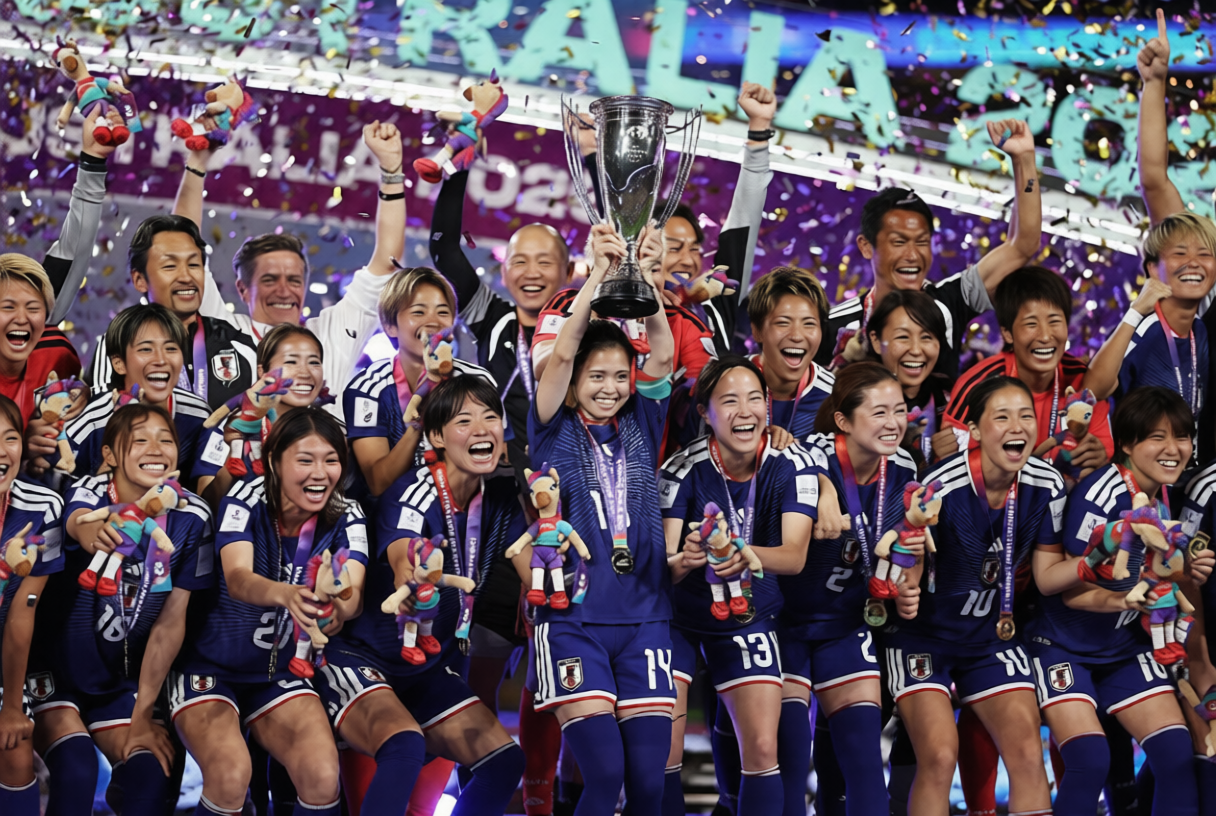
The Japan vs Australia Women’s Asian Cup Final 2026 ended in dramatic fashion as Japan secured a narrow 1-0 victory over hosts Australia to lift the prestigious continental trophy. The final, played at Sydney’s iconic Stadium Australia, witnessed an electrifying atmosphere with a record-breaking crowd, making it one of the most memorable matches in the tournament’s history.
Japan’s victory not only confirmed their dominance in Asian women’s football but also marked their third title in the last four editions, further strengthening their legacy in the region.
The decisive moment of the Japan vs Australia Women’s Asian Cup Final 2026 came early in the match. In the 17th minute, rising star Maika Hamano produced a stunning long-range strike that beat Australia’s goalkeeper and silenced the home crowd.
Hamano’s goal turned out to be the only goal of the match, but its impact was massive. The Japanese side quickly shifted to a more controlled and disciplined approach, focusing on maintaining possession and defending their lead.
Despite Australia’s aggressive attempts to equalize, Japan’s defensive organization proved too strong. The goal not only decided the match but also highlighted Japan’s tactical efficiency and composure under pressure.
The final was played in front of more than 74,000 spectators, setting a new attendance record for the Women’s Asian Cup.
The home fans created an electric environment, supporting the Australian team, popularly known as the Matildas. However, the pressure seemed to work both ways, as Japan remained calm and composed throughout the game.
The match showcased the growing popularity of women’s football in Asia, with record attendance and global viewership reflecting the sport’s rapid development.
Australia started the match strongly and created several early chances. Key players like Sam Kerr and Caitlin Foord came close to scoring, but their finishing lacked precision.
As the match progressed, Australia increased their attacking intensity, especially in the second half. They dominated possession and created multiple goal-scoring opportunities, but Japan’s defense stood firm.
Several crucial chances went begging for the Matildas, which ultimately cost them the title. The frustration was visible as the final whistle blew, leaving the home side heartbroken.
One of the key factors behind Japan’s success in the Japan vs Australia Women’s Asian Cup Final 2026 was their exceptional defensive performance.
Goalkeeper Ayaka Yamashita delivered a standout performance, making several crucial saves to deny Australia an equalizer.
Japan’s defense remained compact and organized, effectively neutralizing Australia’s attacking threats. Even during the final minutes, when Australia pushed forward desperately, Japan managed to maintain their structure and composure.
This defensive discipline has been a hallmark of Japan’s playing style, and it played a crucial role in securing the championship.
Japan’s victory in the final was not a surprise considering their overall performance in the tournament.
- They scored 28 goals throughout the competition
- Conceded only one goal before the final
- Maintained an unbeaten record
Their consistent performance demonstrated their superiority and tactical excellence. From group stages to the knockout rounds, Japan dominated their opponents with skill, precision, and teamwork.
This victory marks Japan’s third Women’s Asian Cup title, having previously won in 2014 and 2018—both times also defeating Australia in the final.
Interestingly, all three finals ended with the same 1-0 scoreline, highlighting Japan’s ability to perform under pressure in crucial matches.
The win also reinforces Japan’s status as one of the strongest teams in women’s football, not just in Asia but globally.
For Australia, the loss was particularly painful as they were playing at home with massive support.
The Matildas had high expectations coming into the final, especially after their impressive performances in earlier rounds. However, their inability to convert chances proved costly.
Despite the defeat, Australia showed resilience and fighting spirit, which will be crucial as they prepare for future international competitions, including the upcoming FIFA Women’s World Cup qualifiers.
The Japan vs Australia Women’s Asian Cup Final 2026 has had a significant impact on women’s football in Asia.
- Record attendance highlights growing fan interest
- Increased global visibility for Asian teams
- Strong competition between top teams
The tournament also served as a qualification pathway for the 2027 FIFA Women’s World Cup, adding further importance to the competition.
Japan’s success is expected to inspire upcoming players and strengthen the development of women’s football across the continent.
Japan will now shift focus to upcoming international tournaments, aiming to build on their success and compete at the global level.
Australia, on the other hand, will look to regroup and address their weaknesses, especially in finishing and decision-making under pressure.
Both teams remain among the top contenders in women’s football, and their rivalry is expected to continue producing thrilling matches in the future.