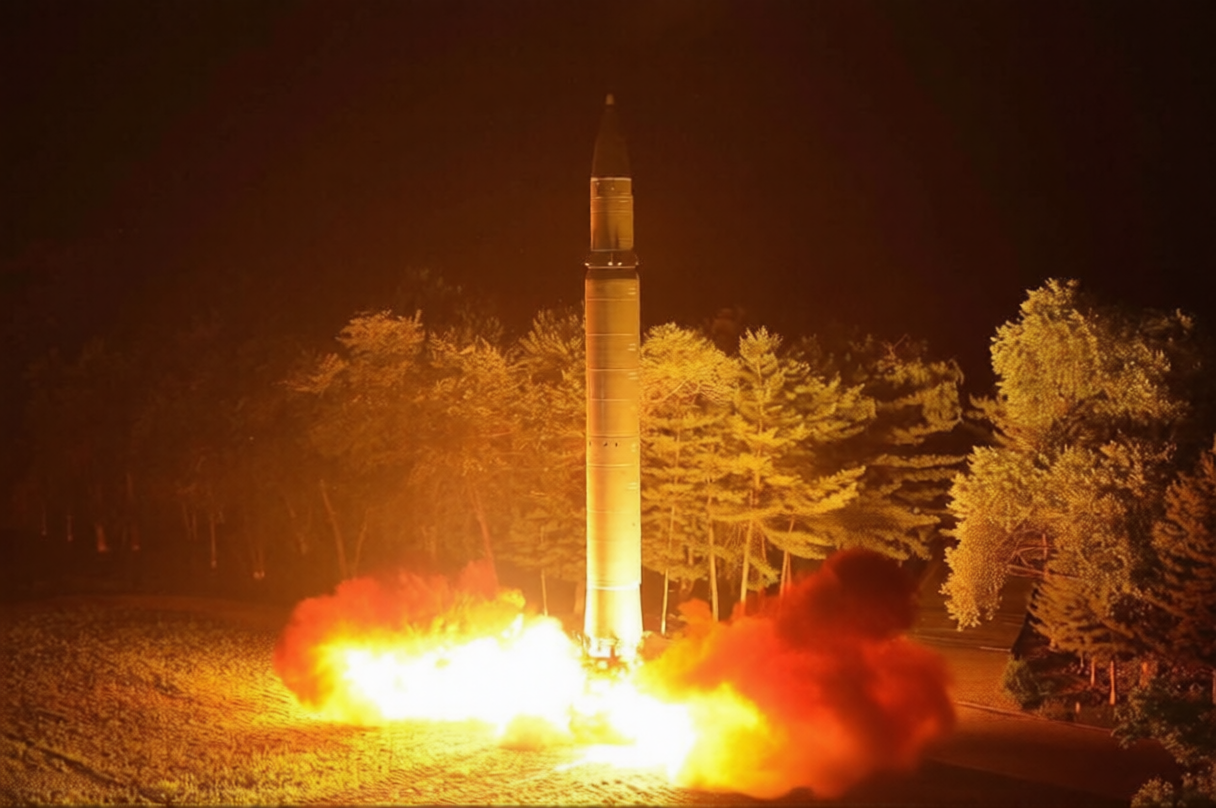
A new North Korea ballistic missile launch has raised tensions across East Asia. Pyongyang fired around ten ballistic missiles into the sea while the United States and South Korea were conducting joint military drills.
South Korea’s military confirmed the launches on Saturday. Officials said the missiles came from an area near the North Korean capital, Pyongyang. The launches marked another show of force by the nuclear-armed country.
The missiles flew toward the eastern sea, which the international community calls the Sea of Japan.
The incident happened while American and South Korean forces were running major annual military exercises. These drills test how well the allies can respond to possible threats from North Korea.
South Korea’s Joint Chiefs of Staff detected the launches in the early afternoon local time. Officials tracked about ten ballistic missiles flying from the Sunan region near Pyongyang.
Military radar showed that the missiles travelled roughly 300 to 350 kilometers before falling into waters off the eastern coast.
Japan also monitored the launches carefully. The Japanese coast guard issued an alert after detecting possible missile activity.
Later, Japanese authorities confirmed that the missiles landed outside Japan’s exclusive economic zone. No damage or casualties were reported.
Military analysts believe the launches were meant as a political message rather than a direct attack. Still, many experts described the action as a strong demonstration of North Korea’s missile capability.
The missile launches happened during the annual US–South Korea joint military exercises. These drills involve thousands of soldiers and advanced military equipment.
Washington and Seoul describe the exercises as defensive training. Their main goal is to improve coordination and readiness against possible attacks.
The drills include several large-scale training operations. Soldiers practice river-crossing missions, armored vehicle maneuvers, and joint air-ground coordination.
Hundreds of troops, tanks, and combat vehicles are taking part in the ongoing exercises.
The United States currently keeps around 28,500 troops stationed in South Korea. This military presence plays a key role in deterring potential aggression from North Korea.
Pyongyang has long criticized these joint military exercises. North Korean officials claim the drills simulate an invasion of their country.
However, both Seoul and Washington strongly reject that accusation.
North Korean leaders frequently warn that such exercises could trigger military responses. Missile launches often happen around the same time as the drills.
Analysts say this pattern has appeared many times during the past decade.
North Korea continues to develop advanced missile technology despite facing international sanctions over its nuclear program.
The country has tested many types of weapons in recent years. These include short-range ballistic missiles, submarine-launched missiles, and intercontinental ballistic missiles (ICBMs).
Some of these missiles can travel thousands of kilometers.
Security experts believe some modern North Korean missiles can carry nuclear warheads. This possibility raises serious concerns about regional and global security.
In recent years, Pyongyang has also introduced new missile technologies. These include solid-fuel missiles and hypersonic weapons.
Such weapons can move faster and may be harder for defense systems to detect or intercept.
The latest North Korea ballistic missile launch has drawn close attention from nearby countries. Governments in Japan, South Korea, and the United States are closely monitoring the situation.
South Korean officials strongly condemned the launch. They described it as a serious threat to peace and stability in the region.
At the same time, Seoul reaffirmed its strong defense partnership with Washington.
Japan also expressed concern about the missile activity. Japanese officials called for stronger international cooperation to prevent further tests.
The launches happened during a period of diplomatic uncertainty with North Korea.
Earlier attempts to negotiate limits on Pyongyang’s nuclear program have stalled in recent years.
Some diplomats have suggested restarting negotiations. However, no major progress has been achieved so far.
North Korea continues to demand recognition as a nuclear-armed state. Meanwhile, the United States insists on full denuclearization.
Political analysts believe missile tests often serve a strategic purpose. Such actions may strengthen North Korea’s position before future negotiations.
Security experts warn that continued missile launches could increase the risk of military miscalculation.
The Korean Peninsula remains one of the most militarized regions in the world.
Technically, the Korean War never ended with a formal peace treaty. The 1950–1953 conflict ended with an armistice, not a permanent peace agreement.
Because of this unresolved status, tensions between North and South Korea frequently rise.
Experts say the latest missile launch shows how volatile the region remains.
Even though the missiles landed in open waters, the test highlights North Korea’s growing strategic capabilities.
Following the launches, surveillance operations increased across the region.
South Korea, Japan, and the United States have intensified monitoring of North Korean military activity.
Officials say additional missile tests cannot be ruled out while the joint military drills continue.
For now, the international community is watching the situation closely.
Diplomatic observers say tensions may either escalate or return to the usual cycle of military demonstrations and warnings.