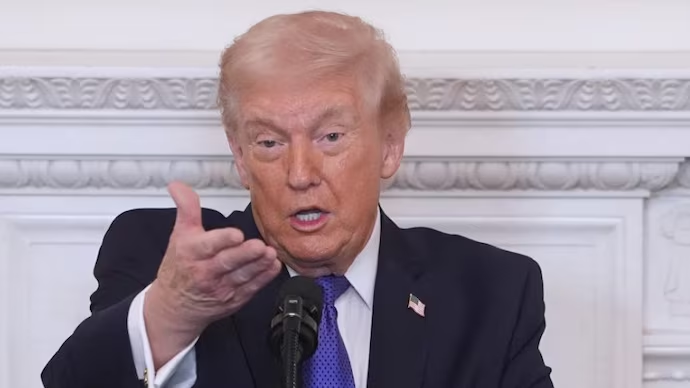
The U.S. Supreme Court struck down major parts of former President Donald Trump’s global tariffs, marking a key legal setback that could reshape global trade and business strategies.
In a landmark decision on February 20, 2026, the Donald Trump tariff regime suffered a major legal defeat as the U.S. Supreme Court struck down several sweeping tariffs he had imposed under emergency powers, significantly impacting international trade and global business strategies.
In a 6–3 ruling, the Court determined that Trump’s use of the International Emergency Economic Powers Act (IEEPA) to levy broad tariffs on imported goods exceeded presidential authority because the U.S. Constitution grants Congress exclusive power over taxation and tariffs.
Chief Justice John Roberts wrote the majority opinion, emphasizing that such sweeping tariff measures require clear authorization from lawmakers, reinforcing the concept of checks and balances and limiting executive power in economic policymaking.
Trump’s tariffs, first announced during his second term, aimed to impose broad duties on foreign imports in order to reduce trade deficits and protect domestic industries. These policies led to tariffs being applied to goods from major trading partners, including China, Vietnam, Mexico, and several European nations.
However, the Supreme Court’s decision held that the president “lacked the legal authority under IEEPA” to impose such tariffs without legislative approval, stating that Congress, rather than the executive branch, holds the constitutional authority to regulate tariff and tax policy.
The ruling specifically struck down the broad “reciprocal tariffs” that formed the backbone of Trump’s global trade agenda, thereby invalidating a significant portion of tariff collections dating back to 2025.
The ruling has immediate implications for global markets and businesses worldwide. Shares of several major retail and apparel companies rallied after the news, reflecting investor expectations of lower input costs and improved supply chain certainty. Stocks for firms like Victoria’s Secret, Lululemon and others saw noticeable gains in trading after the decision.
Despite market optimism, many businesses remain cautious. Thousands of companies are considering whether to pursue refunds for tariffs paid over recent years, with economists estimating that over $175 billion in tariff revenue might be subject to reimbursement or legal claims.
Industry groups note that although the ruling clarifies legal authority, it does not immediately end uncertainty around which tariff policies will govern trade going forward. Many of Trump’s trade measures were enacted through different laws or statutory provisions, meaning the administration could continue pursuing tariffs under alternative legal frameworks.
For global businesses, the Trump tariff loss impact on global businesses is complex. The sudden shift in U.S. trade policy affects multinational supply chains, pricing strategies, and long-term investment decisions.
Companies that depended on stable tariff frameworks to plan sourcing and manufacturing routes are now reassessing their logistics networks amid regulatory ambiguity. Countries with high export exposure to the U.S. market may see shifts in procurement flows, while companies reliant on imported components face cost recalculations.
Experts also warn that while certain tariffs were struck down, others — including those imposed under national security or separate trade statutes — may still remain in place. This hybrid regulatory environment could prolong decision-making delays for businesses considering expansion or restructuring.
The decision sparked debates in political and business communities. Supporters argue it restores constitutional boundaries and protects international trade norms, while critics warn of renewed negotiation challenges and uncertainty.
In response to the ruling, Trump announced a temporary 10% global tariff under alternative trade laws to maintain trade leverage, signaling that the administration will continue using executive authority to influence international commerce.
U.S. lawmakers have also weighed in, with some pushing for clearer congressional statutes governing tariff powers, potentially leading to new trade legislation later this year.
The Trump tariff loss impact on global businesses marks a pivotal moment for U.S. economic policy and world trade. The Supreme Court’s decision curtails presidential authority in tariff imposition and reinforces the constitutional role of Congress. However, uncertainty remains as businesses and policymakers adapt to changing trade law landscapes.
For global enterprises, investors, and trade analysts, this ruling creates a period of reassessment — one that may influence strategic decisions in international commerce for years to come.