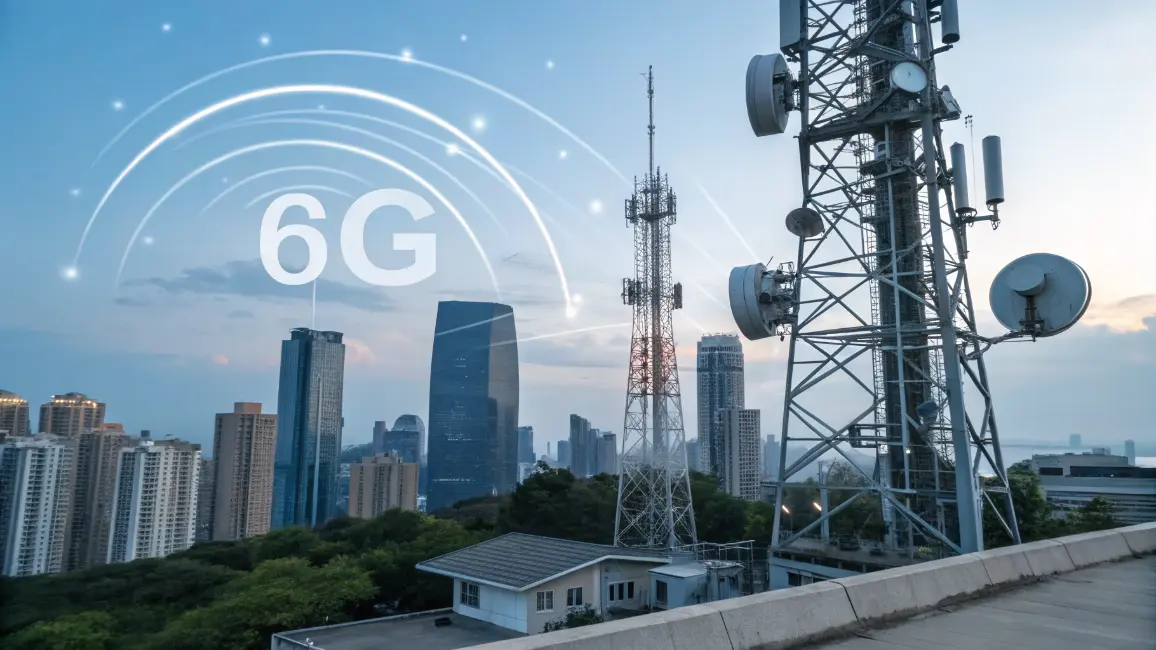
The world is still expanding 5G networks, yet researchers and technology companies are already preparing for the next major leap in connectivity. The topic “6G Internet Explained” is becoming increasingly important as scientists explore how the sixth generation of wireless technology could reshape the digital world.
Experts believe that 6G networks could reach speeds of up to 1 terabit per second, making them nearly 100 times faster than 5G.
Such ultra-fast connectivity could support futuristic technologies such as holographic communication, fully autonomous vehicles, smart cities, and real-time artificial intelligence systems.
Although commercial deployment is expected around 2030, research labs across the United States, China, South Korea, Japan, and Europe are already racing to develop the technology that will power the next generation of the internet.
From Dial-Up to 5G: How Internet Speeds Have Evolved
To understand the significance of 6G Internet Explained, it helps to look at how internet technology has evolved over the past three decades.
Early Internet (Dial-Up Era)
In the late 1990s, most internet users relied on dial-up connections that delivered speeds of around 56 kilobits per second. At that speed:
- Loading a single web page could take several seconds
- Downloading a song could take minutes
- Streaming video was almost impossible
The internet was primarily used for email and simple browsing.
Broadband and 4G Era
The arrival of broadband and later 4G mobile networks transformed the internet. With speeds ranging from 10 Mbps to 100 Mbps, users could:
- Stream HD videos
- Use social media platforms
- Play online games
- Access cloud services
Smartphones also became central to daily digital life during this period.
5G Networks Today
Today’s 5G networks can reach speeds of up to 10 gigabits per second under ideal conditions.
This level of connectivity enables:
- 4K video streaming
- real-time gaming
- smart home devices
- early autonomous vehicle testing
However, as digital demand continues to grow, experts believe even faster networks will soon be necessary.
What Makes 6G Different From Previous Networks?
The next-generation wireless technology will not only focus on speed. Instead, 6G will integrate artificial intelligence directly into network infrastructure.
Researchers predict several key improvements:
Ultra-High Speed
6G networks may reach 1 terabit per second, which is equal to 1000 gigabits per second.
At that speed:
- A 4K movie could download in less than a second
- Massive datasets could be transferred instantly
- Real-time holographic communication may become possible
Extremely Low Latency
Latency refers to the delay between sending and receiving data.
While 5G latency is about 5 milliseconds, 6G could reduce this to less than 1 millisecond, enabling nearly instant communication.
This improvement will be critical for technologies like remote surgery and autonomous transportation.
Terahertz Spectrum
6G networks are expected to use terahertz (THz) frequencies, which allow extremely large data bandwidth.
These frequencies can transmit huge amounts of data but require new infrastructure and advanced communication devices.
Global Experiments and Early 6G Tests
Although 6G is still under development, several experimental breakthroughs have already been reported.
For example, a 6G trial in the United Arab Emirates achieved speeds of around 145 gigabits per second, demonstrating the potential of terahertz communication networks.
Meanwhile, scientists have also developed experimental 6G chips capable of transmitting data at more than 100 gigabits per second, a major step toward real-world deployment.
Research institutions across the world are exploring new antennas, chips, and wireless transmission methods that could support terabit-level communication.
How 6G Could Change Everyday Life
The arrival of 6G networks could significantly transform multiple industries and daily activities.
1. Smart Cities
Future cities may rely on millions of connected sensors that monitor traffic, pollution, and energy usage in real time.
6G networks will provide the speed and capacity needed to manage such massive data flows.
2. Autonomous Transportation
Self-driving cars require constant communication with other vehicles and infrastructure.
Ultra-low latency 6G networks could allow vehicles to react instantly to road conditions, improving safety.
3. Advanced Healthcare
Doctors may perform remote robotic surgeries using ultra-reliable networks.
Medical devices could continuously monitor patients and send real-time data to hospitals.
4. Immersive Virtual Worlds
6G could enable realistic virtual and augmented reality experiences with almost zero delay.
Future online meetings might involve 3D holographic communication, where participants appear as life-size projections.
Economic Impact of 6G Technology
Telecommunications experts believe 6G could create massive economic opportunities.
New industries may emerge around:
- AI-powered networks
- smart manufacturing
- immersive digital entertainment
- space-based internet services
Governments are therefore investing billions of dollars in research and development.
Countries such as the United States, China, South Korea, and Japan are competing to lead the global 6G race.
Challenges Before 6G Becomes Reality
Despite its potential, several technical challenges must be solved before 6G networks become widely available.
Infrastructure Costs
Building terahertz communication networks will require new towers, satellites, and antennas.
Energy Consumption
Ultra-fast networks may consume large amounts of energy, so researchers are working on energy-efficient communication systems.
Coverage Limitations
Terahertz waves do not travel as far as traditional signals, meaning networks may need more base stations to ensure coverage.
Solving these issues will be critical before large-scale deployment can begin.
When Will 6G Internet Launch?
Most analysts believe that commercial 6G networks will begin appearing around 2030.
Before that, several steps must be completed:
- global technology standards
- device compatibility testing
- infrastructure deployment
- spectrum allocation
The late 2020s are expected to see large-scale pilot projects and early adoption.
The Future Internet Landscape
The discussion around 6G Internet Explained highlights how rapidly digital technology continues to evolve.
Just a few decades ago, the internet struggled to load simple web pages. Today, billions of people stream video, communicate instantly, and rely on cloud computing.
If current research succeeds, 6G could usher in an era where ultra-fast connectivity powers intelligent cities, autonomous systems, and immersive digital worlds.
While the technology is still several years away, the race to build the internet of the future has already begun.