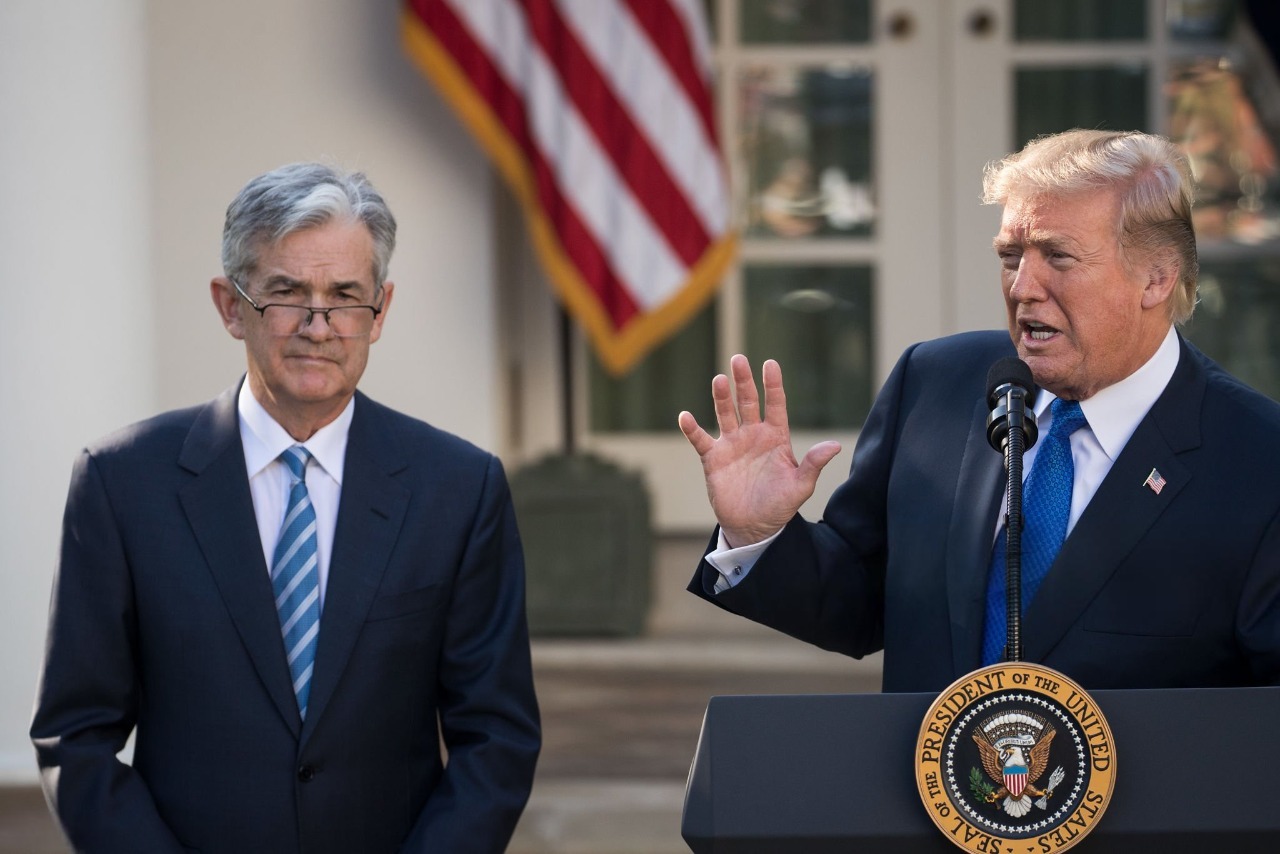
The statement that Trump threatens to fire Fed Chair Powell has once again brought the issue of central bank independence into sharp focus, raising concerns across political and financial circles. Former U.S. President Donald Trump, who remains a dominant figure in American politics, has reportedly signaled that he would consider removing Federal Reserve Chair Jerome Powell if he does not step down voluntarily by May. This development has sparked debate not only in the United States but also across global markets, where investors closely watch signals from the Federal Reserve.
Trump’s relationship with Powell has long been strained. During his presidency, Trump frequently criticized Powell for maintaining higher interest rates, arguing that such policies slowed economic growth and hurt American businesses. Now, with renewed political ambitions, Trump appears ready to revisit that tension. His recent remarks suggest a more aggressive stance, indicating that he may take direct action if given the authority again.
The Federal Reserve, often referred to as the Fed, operates as an independent central bank. Its primary responsibility is to manage inflation, employment, and overall economic stability. Traditionally, U.S. presidents avoid direct interference in the Fed’s decisions to maintain confidence in the financial system. However, Trump’s latest comments challenge this long-standing norm and raise questions about how such actions might impact economic policy.
Financial analysts are already reacting to the situation. Many believe that any attempt to remove Powell could shake investor confidence. The Federal Reserve’s credibility relies heavily on its independence from political pressure. If that independence is perceived to be under threat, markets could experience volatility. Stocks, bonds, and currency values often react quickly to uncertainty, and this situation is no exception.
At the same time, Trump’s supporters argue that the president should have more influence over economic policy. They believe that elected leaders should play a stronger role in shaping decisions that directly affect growth, inflation, and employment. From this perspective, supporters see Trump’s stance as an effort to align monetary policy with broader economic goals. However, critics warn that such influence could lead to short-term political gains at the expense of long-term stability.
Jerome Powell, who has served as Fed Chair since 2018, has largely maintained a steady approach to monetary policy. Under his leadership, the Federal Reserve has navigated challenges such as inflation spikes, global economic uncertainty, and post-pandemic recovery. Powell has emphasized data-driven decisions, focusing on controlling inflation while supporting employment. His cautious approach has earned both praise and criticism, depending on economic conditions and political viewpoints.
The timing of Trump’s statement is also significant. With elections approaching, economic policy is becoming a central issue in political campaigns. Inflation, interest rates, and job growth are key concerns for voters. By targeting Powell, Trump is positioning himself as a leader willing to take bold action to influence the economy. This strategy may resonate with some voters, particularly those who feel the impact of rising costs and borrowing rates.
Global markets are watching closely. The U.S. Federal Reserve plays a crucial role in the world economy. Its decisions influence not only American markets but also international trade, investment flows, and currency values. Any sign of instability or political interference can have ripple effects across countries. Emerging markets, in particular, are sensitive to changes in U.S. monetary policy.
Meanwhile, legal experts point out that removing a Federal Reserve Chair is not a straightforward process. The position is designed to be protected from political pressure, and any attempt to force a resignation could face significant legal challenges. This adds another layer of complexity to the situation, making it uncertain whether Trump could actually follow through on his threat.
Despite the uncertainty, the discussion itself is already having an impact. It highlights the ongoing tension between politics and economic policy. While some argue for stronger political control, others emphasize the importance of independence in maintaining trust and stability. This debate is likely to continue as the political landscape evolves.
In the broader context, the issue reflects a larger trend in global politics. Leaders in various countries have increasingly challenged traditional institutions, seeking greater control over economic decisions. This shift raises important questions about the balance between democratic accountability and institutional independence. The outcome of such debates can shape economic policies for years to come.
For now, Powell has not publicly responded to Trump’s latest remarks. The Federal Reserve continues its work, focusing on economic indicators and policy decisions. However, the situation remains dynamic, and further developments are expected as political campaigns intensify.
Ultimately, the statement that Trump threatens to fire Fed Chair Powell is more than just a headline. It represents a clash of ideas about how economic policy should be managed. On one side is the principle of central bank independence, designed to protect long-term stability. On the other is the argument for greater political influence, aimed at achieving immediate economic goals.
As the story unfolds, its impact will likely extend beyond the United States. Investors, policymakers, and citizens around the world will be watching closely. The decisions made in the coming months could shape not only the future of the Federal Reserve but also the direction of the global economy.